
Have you ever found yourself drowning in a sea of academic papers, struggling to connect ideas across multiple sources? If so, you're not alone. Academic research can feel like assembling a jigsaw puzzle without seeing the complete picture. This is where an academic thinking canvas comes in—a game-changer for how we process complex information in scholarly work.
Understanding Academic Thinking Canvas: A Comprehensive Guide
An academic thinking canvas is a visual framework that helps researchers, students, and knowledge workers organize complex information spatially. Unlike linear note-taking methods, a thinking canvas allows you to map connections between concepts, identify patterns, and build a holistic understanding of your research area.
"Visual thinking tools like academic canvas don't just organize information—they transform how we process knowledge, enabling us to see connections that remain invisible in traditional linear formats."
The academic thinking canvas has evolved significantly from simple mind maps to sophisticated digital thinking workspaces that support multi-dimensional knowledge organization. What sets it apart from traditional methods is its ability to represent relationships between ideas visually, making it easier to spot gaps, contradictions, and synergies in your research.
Why Academic Thinking Canvas is Essential for Modern Research
In today's information-saturated academic environment, the ability to process and synthesize information efficiently is more valuable than ever. Here's why academic thinking canvases have become essential tools:
The Cognitive Benefits of Using a Canvas for Academic Thinking
When you use a thinking canvas, you engage both sides of your brain—the logical left hemisphere and the creative right hemisphere. This whole-brain approach leads to deeper understanding and more innovative thinking.
How Academic Thinking Canvas Transforms Complex Information Processing
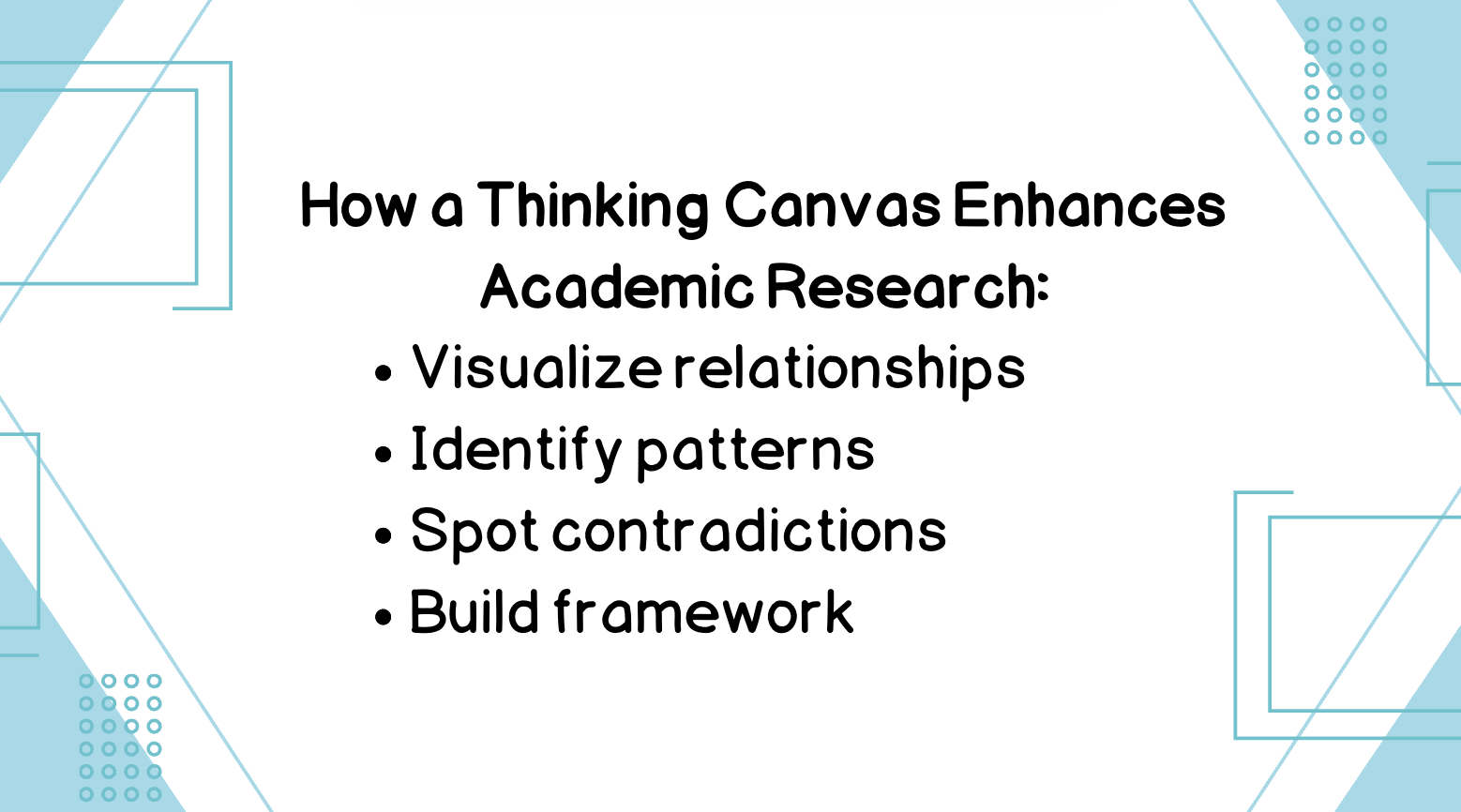
Traditional research methods often involve reading papers sequentially and taking linear notes. This approach makes it difficult to see connections across documents. A thinking canvas, on the other hand, allows you to:
Visualize relationships between concepts from different sources
Identify patterns and themes across multiple papers
Spot contradictions or gaps in existing research
Build a cohesive framework for your own research
Case Studies: Successful Implementation in Leading Universities
Many top institutions now incorporate canvas-based approaches in their research methodology courses. For example, researchers at Stanford have used thinking canvases to map interdisciplinary connections in climate science research, leading to novel approaches that might have remained undiscovered with traditional methods.
The 5-Step Method to Master Your Academic Thinking Canvas
Let's dive into the practical steps for creating and utilizing an effective academic thinking canvas:
Step 1: Establishing Your Core Research Question on the Canvas
Every great academic canvas starts with a clearly defined research question at its center. This question becomes the gravitational core around which all other elements orbit. When formulating your question:
Make it specific enough to guide research but broad enough to allow exploration
Consider using a "how" or "why" format to encourage deeper investigation
Place it prominently in the center of your canvas
Step 2: Organizing Critical Thinking Elements Through Canvas Mapping
Critical thinking is essential for academic rigor. On your canvas, create dedicated spaces for:
Evidence collection (data, quotes, statistics)
Analysis of sources and their credibility
Alternative perspectives or contradicting views
Your evolving hypotheses
Questions that arise during your research
Step 3: Applying Design Thinking Principles to Academic Research
Design thinking isn't just for product developers—it's incredibly valuable for academic research too. On your canvas, incorporate:
Problem statement areas that clearly articulate what you're trying to solve
Empathy maps to understand different stakeholder perspectives
Ideation spaces where you can brainstorm freely without judgment
Step 4: Building Interconnected Knowledge Structures
This is where the magic happens! Use your canvas to:
Draw connections between related concepts with different types of lines or arrows
Color-code information by source, reliability, or theme
Create hierarchies of information from fundamental to specialized
Step 5: Iterative Refinement and Expansion of Your Academic Canvas
Your academic thinking canvas is a living document that evolves as your understanding deepens. Schedule regular reviews to:
Integrate new research findings
Reassess connections between concepts
Identify areas requiring further investigation
Collaborate with peers for fresh perspectives
Common Challenges in Academic Thinking Canvas Development
Challenge | Traditional Approach | Canvas Approach with Ponder |
|---|---|---|
Information overload | Sequential reading and linear notes | Visual mapping that highlights key concepts |
Lost connections between papers | Separate notes for each paper | Integrated knowledge map across multiple sources |
Difficulty seeing the big picture | Fragmented understanding | Holistic view with clear relationships |
Time-consuming manual organization | Hours spent organizing notes | One-click PDF upload with AI-generated structure |
Limited collaboration | Sharing static documents | Dynamic, collaborative knowledge space |
How Ponder AI Revolutionizes Academic Thinking Canvas
Traditional thinking canvases require significant manual effort. This is where Ponder AI transforms the research experience:
Transforming PDFs into Interactive Knowledge Maps
With Ponder's one-click PDF upload feature, academic papers are automatically transformed into structured knowledge maps. Instead of manually extracting key points, the AI identifies:
Core arguments and supporting evidence
Methodological approaches
Key findings and limitations
AI-Powered Multi-Document Analysis for Enhanced Canvas Creation
One of the most powerful features of Ponder is its ability to analyze multiple documents simultaneously, identifying:
Common themes across papers
Contradictory findings
Complementary methodologies
Gaps in existing research
This multi-document comparison makes it 10x faster to grasp connections between different papers—something that would take days with traditional methods.
Creating Dynamic Academic Thinking Canvases with Ponder
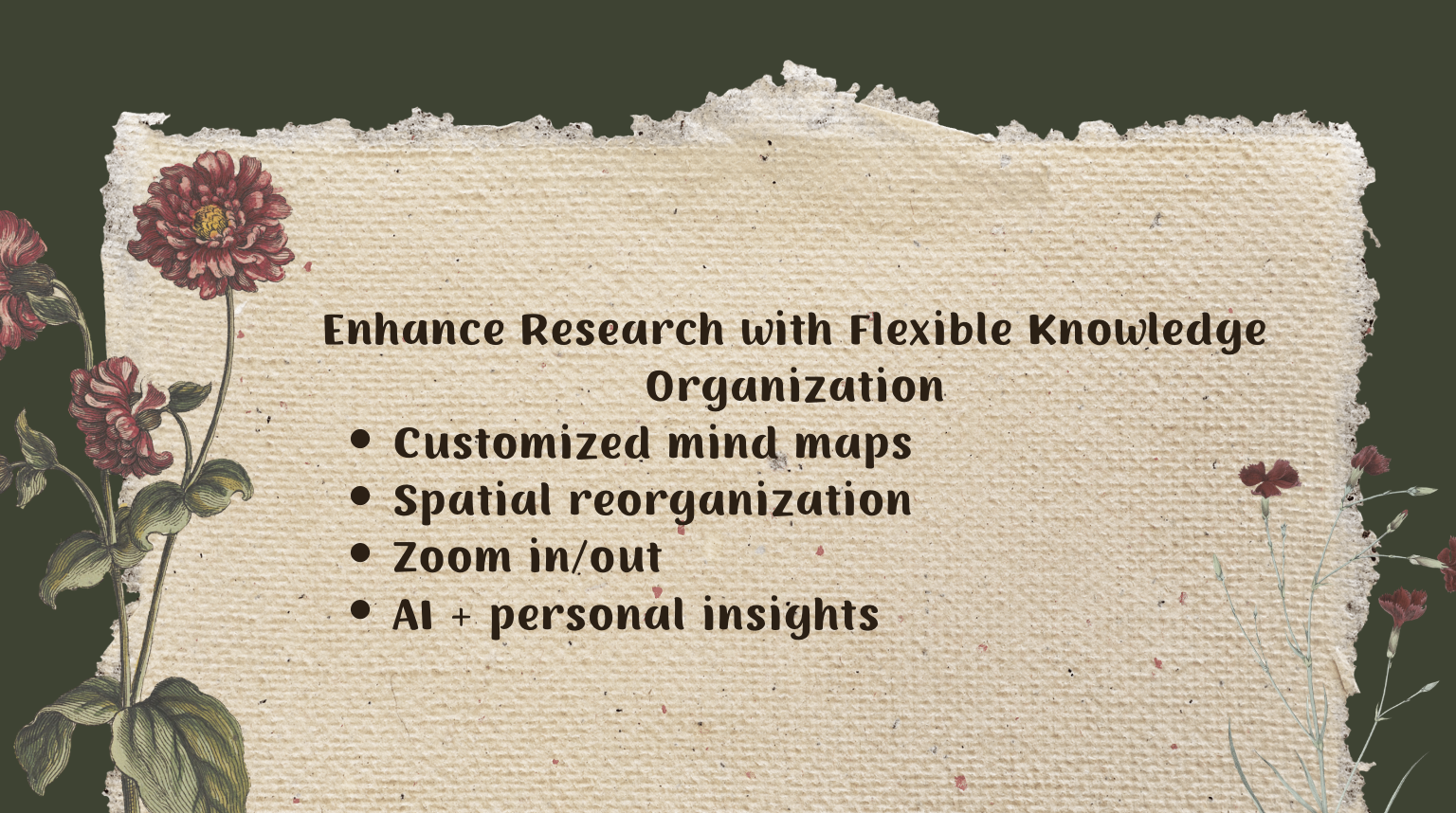
Ponder's flexible knowledge organization allows you to:
Build customized mind maps based on your specific research needs
Reorganize information spatially to reflect your thinking process
Zoom in on details or out for the big picture
Add your own insights alongside AI-generated content
Academic Thinking Canvas Applications Across Disciplines
Whether you're in STEM fields, humanities, or social sciences, academic thinking canvases offer tremendous value. In scientific research, they help visualize experimental design and results. In humanities, they map theoretical frameworks and textual analyses. For professional academic writing, they provide a bird's-eye view of your argument structure.
The Future of Academic Thinking Canvas in Higher Education
As AI technologies continue to advance, academic thinking canvases will become even more sophisticated. By 2025, we can expect:
Real-time integration of new research into existing canvases
Predictive suggestions for research directions
Virtual reality experiences for immersive knowledge exploration
Cross-institutional collaboration on shared academic canvases
Conclusion: Mastering Academic Thinking Canvas for Lifelong Learning Success
The academic thinking canvas is more than just a tool—it's a different way of approaching knowledge management that aligns with how our brains naturally make connections. By following the five steps outlined in this guide and leveraging advanced research tools like Ponder AI, you can transform how you process academic information.
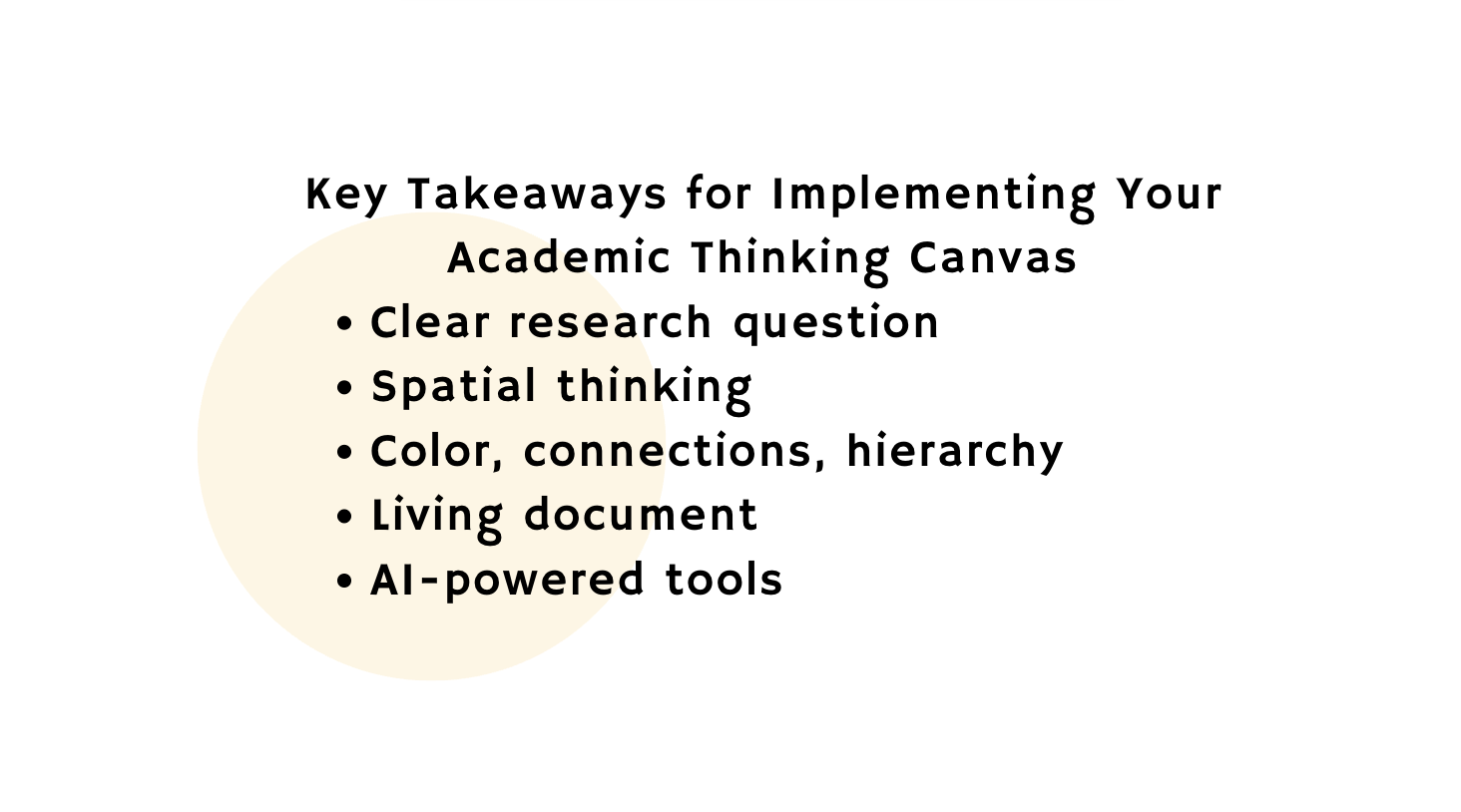
Key Takeaways for Implementing Your Academic Thinking Canvas
Start with a clear research question at the center
Embrace spatial thinking rather than linear note-taking
Use color, connections, and hierarchy to organize information
Make your canvas a living document that evolves with your understanding
Consider AI-powered tools like Ponder to automate the heavy lifting
Ready to revolutionize your research process? Begin your journey with Ponder's academic canvas tools today and experience the difference that spatial, connected thinking can make in your academic pursuits.