
How Ponder AI Helps You Write Research Papers Efficiently with AI Tools for Research Paper Writing
 ·7/28/2026·14 min read
Researchers face an overwhelming volume of literature, fragmented notes, and repetitive drafting tasks that slow progress on papers and theses. This article explains how an AI-powered knowledge workspace can reduce context switching, accelerate literature synthesis, and support clearer argument development while preserving intellectual rigor. You will learn practical workflows for discovery, visual knowledge mapping, iterative summarization, and export strategies that integrate with common academic writing habits. The guide maps the stages of research paper writing—discovery, synthesis, mapping, drafting, and ethical use—and shows concrete techniques to save time without sacrificing depth. Throughout, targeted keywords like research paper writing, AI summarization for research, and visual knowledge mapping are woven into actionable steps researchers can apply to their own projects.
Ponder AI is an all-in-one knowledge workspace designed to help researchers explore, connect, and evolve thinking without flipping between multiple tools. Its core value propositions are deep thinking (not just speed), an integrated workspace that keeps documents and notes linked, an AI thinking partner called an agent, and automatic conversion of uploaded materials into visual, interactive knowledge maps. Ponder supports uploads of PDFs, videos, text, and web pages for AI-driven analysis, summarization, and insight generation, and it creates exportable research assets such as mind maps and interactive HTML or PNG exports.. This brief introduction positions Ponder as a practical example throughout the article while keeping the primary focus on methods researchers can apply to streamline their workflows.
Quick answer: Academic research paper writing follows a structured process: introduction (problem + gap + contribution), literature review (contextualize your work), methodology, results, discussion, conclusion. The hardest part is the literature review and discussion, which require synthesis across sources. Use Zotero for citations, Overleaf for LaTeX formatting, Grammarly for editing. For synthesis — mapping how your sources relate before writing — Ponder's canvas helps you build the argument structure visually before drafting text.
What Makes Ponder AI the Ultimate Knowledge Workspace for Efficient Academic Writing?

An ultimate knowledge workspace combines AI canvas unified access to sources, and tools that encourage deeper conceptual exploration rather than only faster output. By reducing context switching between file managers, note apps, and writing editors, researchers maintain a single semantic graph of ideas, evidence, and questions that feeds into drafts and maps. The result is a workflow where evidence is traceable back to original sources, claims are linked to supporting nodes, and iterative questioning refines hypotheses before formal drafting begins. This section explains how integrated features support deep thinking and gives a short example workflow that researchers can adopt immediately.
Ponder’s design encourages deep thinking through iterative questioning and connections that surface blind spots and alternative hypotheses. The platform’s AI agent prompts targeted questions, highlights contradictions across documents, and suggests lines of inquiry that expand conceptual scaffolding rather than simply producing text. This fosters a practice where researchers test assumptions early and refine conceptual frameworks before committing to formal drafts, improving both clarity and reproducibility. The emphasis on conceptual clarity supports stronger argumentation and leads naturally into features that integrate research, note-taking, and questioning.
Ponder integrates document ingestion, linked notes, and threaded questions to keep research coherent across files and thoughts. It automatically extracts key passages when you upload PDFs or web pages, ties highlights to note nodes, and preserves provenance so each claim in a draft links to an evidence node. Linked question threads let you track unanswered queries alongside summaries, which encourages returning to the literature with precise search terms instead of re-reading whole documents. These capabilities create a feedback loop where reading informs questions, questions refine searches, and refined searches build stronger evidence maps for writing.
This integrated feature set translates into a simple example workflow researchers can try:
Ingest a corpus of papers and web pages into the workspace.
Generate automated summaries and highlight candidate evidence.
Build an interactive map connecting claims, methods, and contradictions.
Iterate with the AI agent to surface gaps and then export structured notes for drafting.
Such an iterative workflow reduces redundant reading and centralizes evidence, making the jump from synthesis to draft far more efficient when compared to disjointed note-taking methods.
How Does Ponder AI Streamline Research Discovery and Literature Review with AI?
Ponder streamlines discovery and literature review by ingesting multiple documents, helping you extract key ideas and organize them into interactive mind maps and summaries that are easier to search and navigate. The AI suggests connections and structures that make it easier to spot dominant ideas and relationships across your sources, while leaving detailed interpretation and cross-paper comparison to the researcher.. This automated synthesis reduces manual triage and frees time for critical evaluation and interpretation rather than clerical summarization. Below is an EAV-style comparison of typical literature-review tasks and how automated synthesis maps to researcher outcomes.
Automated literature-review capabilities can be described succinctly in a table that contrasts core features, attributes, and researcher outcomes for multi-paper workflows.
Capability | Attribute | Outcome |
|---|---|---|
Automated summaries + thematic clustering | Rapid identification of recurring findings across dozens of papers | |
Evidence extraction | Citation and excerpt linking | Traceable support for claims with provenance |
Topic discovery | Keyword co-occurrence and concept clustering | Fast surfacing of under-explored areas and dominant themes |
This comparison shows how automated synthesis turns collections of documents into actionable, evidence-linked outputs that are immediately useful for building literature reviews and framing contributions. The table highlights that automation does not replace judgment; it accelerates the discovery phase so researchers can apply critical reasoning to high-value tasks.
How Can Ponder AI Automate Literature Review and Synthesis?
Automated literature review works by convert research paper to concept map structured summaries and clustering them by theme to reveal patterns across methods and findings.The AI helps surface key sections and findings from each document and can assist in organizing them into comparable nodes or sections in your map, which you can then refine into more detailed methodological or results comparisons as needed. This approach reduces the initial triage time dramatically and allows users to focus on verification, interpretation, and synthesis rather than manual note consolidation. The practical walkthrough is simple: upload a corpus, run a synthesis job to generate themes, then inspect clustered evidence nodes and refine queries for gaps and contradictions.
While AI tools can significantly accelerate the literature review process, it's crucial to acknowledge their inherent limitations in academic writing. A case study highlights that AI may struggle with conventional rhetorical moves, accurate citation formatting beyond APA, disclosing training data, incorporating contemporary knowledge, understanding non-Anglophone cultural contexts, and maintaining a formal writing style, underscoring the continued necessity of human oversight and critical engagement.
How Does Ponder AI Help Identify Research Gaps and Relevant Sources?
Gap detection in practice involves using Ponder’s maps and AI prompts to notice areas where concepts are thinly connected, questions remain unanswered, or findings appear to be in tension across sources. The system helps surface these potential gaps by suggesting follow-up questions and highlighting underdeveloped branches in your map, but researchers still need to interpret where genuine research opportunities lie. Researchers can use these signals to prioritize follow-up reading or to craft research questions that address observed inconsistencies. Pairing this with focused searches across uploaded and web-sourced materials helps surface seminal works and overlooked evidence that strengthen a literature review’s foundation.
How Does Visual Knowledge Mapping Enhance Academic Papers with Ponder AI?
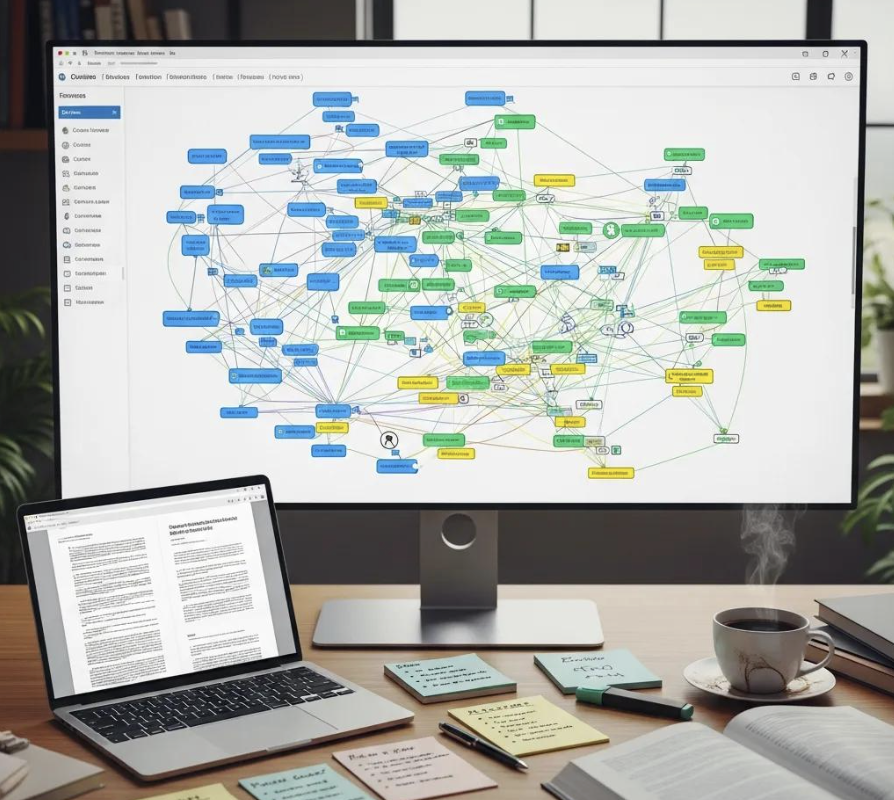
Visual knowledge mapping represents ideas, evidence, and relationships as interactive nodes and edges, which helps researchers structure arguments and trace evidence more clearly. Maps make conceptual relationships explicit: claims become nodes, supporting evidence links connect to source nodes, and annotations capture methodological nuances. This reduces cognitive load when organizing complex literatures and aids retention by spatially grouping related concepts. The next subsection defines interactive knowledge maps and outlines practical reasons to use them in the reporting and drafting stages of academic work.
Interactive knowledge maps combine nodes, edges, annotations, and metadata to create navigable representations of a research domain. Nodes typically represent concepts, findings, or papers, while edges denote causal, methodological, or citation relationships; annotations store excerpts, interpretations, and provenance. These maps improve comprehension and memory by visually clustering related evidence and revealing structural gaps that text-only notes obscure. Researchers can export snapshots of maps to include as evidence appendices or to guide the structure of a manuscript’s argumentation.
Ponder connects complex ideas across documents by using AI to suggest relationships between notes and sections in your mind map, and by letting you manually create, merge, and reorganize nodes. The system helps you notice recurring ideas and relationships, while leaving you in control of which connections to keep, refine, or remove. Users refine suggested links, add their own annotations, and build an argument map that traces a concept’s evolution across sources. This combination of automated linking and manual curation produces reliable, human-vetted maps that translate directly into more coherent literature reviews and structured arguments.
Visual maps offer several practical benefits for academic work:
Improved retention by organizing evidence spatially.
Faster pattern recognition across methodologies and results.
Clearer argument scaffolding for drafting and peer discussion.
These benefits help researchers convert dispersed notes into persuasive, traceable narratives that support stronger research papers.
How Does Ponder AI Support Drafting, Refining, and Exporting Research Papers Efficiently?
AI-assisted drafting and summarization help refine argument structure by turning evidence nodes into structured outlines and iterative drafts. Summaries condense findings into claim-evidence pairs that can populate an outline, while the AI agent suggests transitions, counterpoints, and unanswered questions to tighten logic. Export options then enable moving work into preferred writing environments, preserving core structure to minimize reformatting. Below is an EAV-style table outlining key export options, what they preserve, and recommended downstream uses.
Export Format | Preserves | Best Use Case |
|---|---|---|
Mind map export | Nodes, structure, and visual layout in formats such as PNG and interactive HTML | Presentations, sharing visual overviews with collaborators, and embedding interactive maps in web contexts where supported |
Structured report | Sectioned summaries and evidence tables | Sharing synthesized findings with collaborators or supervisors |
Mind map export | Nodes and edges with annotations | Importing into visualization tools for presentations or brainstorming |
Understanding these export characteristics helps researchers choose the right downstream tool to maintain traceability and reduce rework during manuscript preparation.
How Does AI Summarization Help Refine Arguments and Improve Clarity?
AI summarization condenses complex findings into precise claim-evidence pairs, which researchers can slot into outlines to strengthen argument flow. Summaries extract main results, note limitations, and surface conflicting evidence so authors address counterarguments proactively. Iteratively summarizing sections and then re-summarizing aggregates reduces redundancy and clarifies the central contribution of each paragraph in a draft. Using summaries as inputs to outlines shortens the drafting cycle and results in cleaner, more defensible manuscripts.
What Export Options Does Ponder AI Offer for Structured Research Assets?
Export options include mind-map formats such as PNG images and interactive HTML for visual sharing and presentations, along with related structured exports where available in the product. Each export preserves different aspects of your workspace: Markdown keeps textual structure and inline excerpts, reports package syntheses and evidence tables, and mind maps retain visual relationships and annotations. Choosing the appropriate export preserves provenance and reduces the need to reconstruct evidence links manually in other tools. These export capabilities make it straightforward to migrate structured content into Overleaf-style LaTeX workflows, collaborative documents, or personal knowledge repositories.
How Is Ponder AI Tailored for Researchers, Students, and Knowledge Workers?
Ponder supports different user profiles with patterns that scale from semester-long projects to multi-year dissertations by maintaining a living knowledge graph that grows with the project. For PhD researchers, persistent maps and traceable evidence chains serve as chapter scaffolds and ensure every claim maps back to a source. For students, streamlined ingestion and auto-summaries accelerate essay planning and citation-ready exports. For analysts and knowledge workers, rapid evidence-to-insight workflows reduce time from data ingestion to actionable reports. The next subsections show concrete scenarios demonstrating these tailored workflows in practice.
Ponder assists PhD researchers by enabling long-duration, traceable workflows where literature maps evolve alongside conceptual frameworks and draft chapters. Researchers build persistent nodes that represent ongoing arguments, tag evidence for chapter sections, and export curated subsections directly into chapter drafts. This living-map approach reduces duplicated reading and preserves provenance for every citation, which is invaluable when defending methodological choices or reconstructing the evolution of an argument. Maintaining this continuity across years of work strengthens both the efficiency and integrity of dissertation writing.
Students and analysts benefit from templated workflows that turn rapid synthesis into citation-ready outputs with minimal friction. Quick-start tips include focused corpus ingestion for coursework, generating thematic summaries to build essay outlines, and exporting Markdown notes for reproducible lab reports. Analysts can use evidence-mapping templates to assemble methods-to-finding linkages and produce structured reports for stakeholders. These workflows reduce time spent on formatting and allow users to concentrate on interpretation and clear communication of results.
To fully leverage these capabilities, researchers can explore various Ponder AI pricing plans, including options tailored for students and professionals. Understanding the subscription options helps users choose the best fit for their project scale and duration.
Ready to begin your efficient research journey? You can easily sign up for Ponder AI and start exploring its features with a free trial. This allows you to experience firsthand how the platform streamlines your academic writing.
Why Is Ethical AI Use and Data Privacy Important in Ponder AI for Academic Writing?
Ethical AI use and data privacy are central to preserving researcher autonomy, protecting unpublished data, and maintaining trust in generated outputs. Researchers should consider how their data is stored, who can access it, and whether uploaded material is used to improve models. Transparency around data handling, retention, and opt-out controls affects willingness to upload sensitive manuscripts or proprietary datasets. Below is a compact EAV-style table summarizing privacy and ethical attributes researchers typically evaluate when choosing AI-assisted workspaces.
Policy Area | Attribute | Researcher Impact |
|---|---|---|
Data usage | Upload processing and storage | Determines whether unpublished work remains confidential |
Model training | Explicit training opt-out options | Affects whether user content is used to retrain underlying models |
Retention & control | Deletion and export controls | Enables portability and compliance with institutional rules |
How Does Ponder AI Ensure Data Privacy and Responsible AI Use?
Ponder’s public materials describe an integrated workspace that treats uploaded documents as inputs for analysis and visualization while providing controls for asset export and structured outputs. Researchers should consult the platform’s privacy documentation to confirm specifics around retention, access controls, and any model-training policies before uploading sensitive data. Practical controls typically include the ability to export and delete workspace content, set sharing permissions for collaborators, and review how outputs are generated from inputs. Establishing these controls and reviewing documentation supports secure and responsible use of AI tools in academic projects.
What Are Best Practices for Using AI Tools Ethically in Research Paper Writing?
Ethical use of AI in academic writing requires disclosure, verification, and provenance tracking to maintain scholarly integrity and reproducibility. Disclose AI assistance in methods or acknowledgements, verify AI-generated summaries against original sources, and preserve traceable links from claims back to evidence. Avoid presenting AI-generated interpretations as original analysis without human validation, and use the workspace’s export and version controls to keep verifiable records of how content evolved. These practices ensure that AI acts as a thinking partner that augments, rather than obscures, rigorous scholarship.
Disclose AI assistance: State the role of AI tools in methods or acknowledgements.
Verify outputs: Cross-check summaries and claims against original sources.
Preserve provenance: Keep traceable links from assertions back to evidence.
Following this checklist helps researchers adopt AI-supported workflows responsibly while reaping productivity gains from automated synthesis and mapping.
For a comprehensive understanding of the platform's usage guidelines, users should also review the Ponder AI Terms of Service. This ensures compliance and clarity regarding the responsibilities of both the user and the service provider.
This article has laid out how an integrated knowledge workspace, exemplified by Ponder AI’s combination of multi-document synthesis, interactive mapping, AI-assisted questioning, and exportable assets, can accelerate research paper writing without sacrificing depth. Researchers should balance automation with verification, use mapping to structure arguments, and confirm privacy controls before uploading sensitive materials to any AI workspace. By applying these methods—focused discovery, iterative mapping, targeted summarization, and ethical safeguards—writing research papers becomes faster, clearer, and more defensible.
Frequently asked questions
How does Ponder help with writing a research paper?
Ponder helps at the research and synthesis stages of paper writing — the phases before you start drafting. Key ways Ponder supports research paper writing: Literature discovery: search 200M+ academic papers directly in Ponder to build your bibliography; Paper reading: upload PDFs and ask questions — "what methodology did they use?", "what are the limitations?"; Cross-paper synthesis: ask questions across your entire paper collection — "what do these sources say about gap X?"; Research canvas: visualize connections between ideas from different sources before drafting your argument; Project organization: separate Ponder projects for different sections or research threads. Ponder is not a writing tool — it doesn't generate your paper's text. It's designed for the research phase: finding relevant literature, understanding it deeply, and synthesizing insights that become your original contribution.
What are the best AI tools for research paper writing?
Best AI tools by research paper writing phase: Literature discovery: Semantic Scholar (free search), Ponder (search + synthesis), Elicit (question-based discovery). Paper reading: Ponder (PDF Q&A + annotation), SciSpace (jargon explanation). Synthesis and argument building: Ponder (multi-document Q&A), Elicit (data extraction). Citation management: Zotero (free, generates formatted citations, best overall). Drafting assistance: Claude or ChatGPT (for outline feedback and high-level editing — not for generating academic text). Grammar and style: Writefull (academic English, integrates with Overleaf), Grammarly. LaTeX: Overleaf (free, collaborative LaTeX writing, Writefull integration). The key principle: use AI for process support and editorial feedback, not for generating the substantive intellectual content of your paper.
Can AI write a research paper for me?
AI can generate text that resembles a research paper, but submitting AI-generated text as original academic work violates academic integrity policies at virtually all institutions and most journals. The substantive contributions — original argument, data interpretation, critical analysis — must be yours. Legitimate academic uses of AI in paper writing: using Ponder to synthesize literature you've read; using Grammarly or Writefull to improve grammar and academic style; asking Claude to critique your argument structure (using it like a reviewer, not a ghostwriter); using AI to understand papers in fields adjacent to your expertise. The research community is actively developing AI use policies. Generally: transparent AI use for process support is increasingly acceptable; AI text generation without disclosure is not.
How should I organize sources for a research paper?
A systematic source organization approach: (1) Citation manager (Zotero, free): capture every source immediately as you find it — never manually type a citation. Use the Zotero browser extension to save papers in one click. (2) Reading and annotation: read key papers in a tool that lets you highlight and attach notes — Zotero's built-in PDF reader, Ponder, or your PDF editor of choice. (3) Thematic organization: create Zotero collections or Ponder projects organized by argument thread, not by author — "papers supporting X", "papers questioning Y". (4) Source-to-argument tracking: before writing, create a simple table: your argument point → supporting sources → key quotes. This prevents losing the citation trail when you draft. Ponder's research canvas can serve as this visual argument-to-source map during synthesis.
What is the difference between a research paper and a literature review?
A research paper presents original findings — new data you collected, experiments you ran, or novel analysis you conducted. It uses existing literature to frame and contextualize your contribution. A literature review synthesizes existing research without adding new primary data — it maps what the field knows, identifies gaps, and situates the current state of knowledge. Some research papers contain a literature review section as one component. Standalone literature reviews are a primary output in some fields and are required components of systematic reviews (most rigorous, protocol-driven synthesis of all available evidence) and meta-analyses (statistical synthesis of results across multiple studies). For students: a literature review for a course or thesis chapter is typically a narrative synthesis of your sources' key findings, organized thematically rather than source-by-source. Tools like Elicit and Ponder are particularly useful for this kind of cross-source synthesis work.
See also: Best AI Research Tools 2026 | Best AI Tools for Academic Research Writing | Best AI Tools for Systematic Literature Review | Best AI Tools for PhD Students | Best Zotero Alternatives