

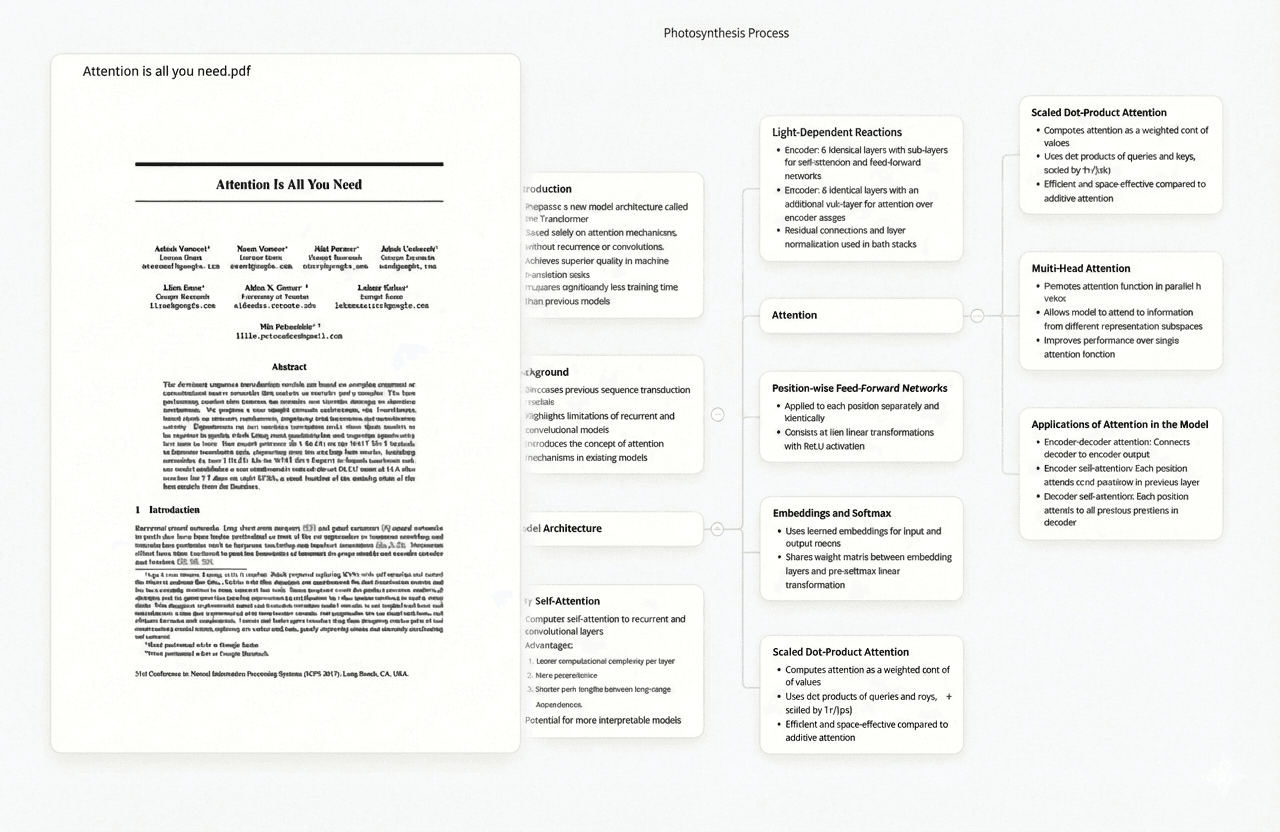
Ponder — When You Need to Synthesise Across All Your Included Studies
Ponder addresses the phase of a systematic review that most review software ignores: what do all your included studies actually say, taken together? After screening is complete and data extraction forms are filled in, researchers still need to synthesise the full text of dozens or hundreds of papers into a coherent evidence narrative. That is the step that takes months in a traditional systematic review — and the step that Ponder specifically accelerates.
You upload the PDFs of all included studies to a Ponder project, then ask cross-paper questions: "What comparators did these RCTs use?" or "How do these studies define the primary outcome?" Ponder returns answers with page-level citations — the exact page number in each paper where the claim appears, not just a file name. This makes verification fast and makes the synthesis auditable in a way that notes-from-memory never are. For systematic reviewers writing a narrative synthesis or preparing a discussion section, Ponder bridges the gap between extracted data tables and a written evidence summary.
Try Ponder free — no credit card required
Try Ponder for academic research →
- Upload included study PDFs and ask questions across the entire collection simultaneously
- Get page-level citations — exact page numbers from each paper, not just document-level attribution
- Identify inconsistencies in how studies define key variables without reading every paper again
- Accelerate narrative synthesis sections that usually require multiple full-text re-reads
- Ask "what are the limitations mentioned across these studies?" and get a synthesised answer in seconds
- Maintains an audit trail — every claim is traceable to a specific page in a specific study
Rayyan — When You Need AI-Assisted Title and Abstract Screening
Rayyan is the most widely used AI screening tool for systematic reviews, with over two million users across research institutions globally. Its core value is reducing the manual effort of title and abstract (T&A) screening — the first filter applied to search results before full-text review. Rayyan's inclusion/exclusion suggestions are generated by a machine learning model trained on your team's actual screening decisions, improving accuracy as the review progresses.
For teams doing reviews with large initial search yields — 5,000 to 20,000 records is common in clinical systematic reviews — Rayyan's AI suggestions allow one reviewer to effectively pre-sort the queue, reducing what the second reviewer needs to independently assess. Conflict resolution is built into the interface: when two reviewers disagree, Rayyan flags the conflict and provides a discussion thread. The platform is free for public reviews and charge-free for academic use, which makes it the default starting point for most research teams undertaking their first systematic review.
- AI screening suggestions based on your team's inclusion/exclusion decisions — learns as you screen
- Dual-reviewer workflow with automatic conflict identification and resolution tracking
- Bulk import from PubMed, Embase, Cochrane, Scopus, and other standard search databases
- Filtering and labelling by study design, population, intervention, and outcome for priority screening
- Blind mode prevents reviewers from seeing each other's decisions until both have screened
- Free for public (open-access) systematic reviews; institutional pricing for private reviews
Covidence — When You Need a Full Review Workflow in One Platform
Covidence is the platform recommended by Cochrane — the gold-standard body for systematic review methodology — for managing the complete review process: import, deduplication, title/abstract screening, full-text screening, data extraction, and risk-of-bias assessment. Where Rayyan specialises in the screening phase, Covidence manages the entire pipeline from first import to final data export and is commonly required by institutions submitting Cochrane reviews.
Its data extraction templates are configurable: you define the fields required for your review (population characteristics, intervention details, outcome measures, effect sizes), and both reviewers extract independently before a third reviewer resolves conflicts. The platform's structured approach creates a review record that is auditable, reproducible, and compatible with meta-analysis software like RevMan and robvis. The cost — a one-time review fee rather than a subscription — is higher than Rayyan but standard in well-funded institutional review projects.
- Complete workflow from import to data export — deduplication, T&A screening, full-text review, extraction
- Cochrane-endorsed and required for Cochrane review submissions
- Configurable data extraction forms with dual-extraction and conflict resolution built in
- Risk-of-bias assessment tools aligned with Cochrane RoB 2 and ROBINS-I frameworks
- Export to RevMan, robvis, and other meta-analysis tools without manual data reformatting
- Per-review pricing model — pay once per review, no recurring subscription
Elicit — When You Need Structured Data Extraction Across Included Papers
Elicit's data extraction capability is the most precise AI-assisted extraction tool currently available for systematic reviews. You define custom extraction columns — sample size, intervention arm, primary outcome measure, effect size, follow-up duration — and Elicit populates them across every included paper automatically, drawing direct quotes from the source text to support each extracted value. This reduces the hours spent reading methods and results sections line by line in search of specific data points.
The verification workflow is critical to its usefulness in systematic reviews: Elicit shows the direct quote it used to populate each table cell, with the surrounding context. A reviewer can verify or correct any extraction without finding the relevant passage in the full text. This quote-level transparency distinguishes Elicit from general-purpose AI extraction approaches, where you cannot see what evidence the model used for a given data point. For high-volume extractions — pulling the same twenty variables from forty papers — Elicit can reduce extraction time by 60–70% on well-structured empirical papers.
- Custom extraction columns: define any data field and Elicit extracts it from every included paper
- Direct quote verification — shows the text passage used for each extracted value
- Up to 5,000 papers on the Pro plan for large-scale systematic or scoping reviews
- PICO (Population, Intervention, Control, Outcome) structured extraction built into default templates
- Export to CSV for integration with RevMan, meta-analysis R packages, or institutional data repositories
- Handles PDFs, DOIs, and direct uploads — no reformatting of included studies required
EPPI-Reviewer — When Your Review Requires Complex Multistage Screening
EPPI-Reviewer is developed by the EPPI Centre at University College London and is the tool of choice for systematic reviews with complex screening logic: multiple stages, mixed-methods synthesis, qualitative evidence synthesis, or reviews that combine trials with observational data. Where Covidence and Rayyan handle standard binary-inclusion screening well, EPPI-Reviewer supports conditional screening trees, custom coding frameworks, and the kind of layered, iterative screening processes required by Campbell Collaboration reviews and complex intervention evaluations.
Its AI screening module — trained on your team's coding decisions — achieves high recall rates on T&A screening for health and social science reviews, and it is one of the few platforms capable of tracking inter-rater reliability statistics alongside screening decisions for publication in methods sections. EPPI-Reviewer is available at no cost through the EPPI Centre for academic researchers, though multi-user reviews with large teams typically require a paid institutional licence.
- Multi-stage screening with conditional decision trees — not limited to binary include/exclude
- Handles mixed-methods and qualitative evidence synthesis, not just quantitative RCT reviews
- AI screening module trained on team decisions with inter-rater reliability statistics
- Custom coding frameworks for thematic synthesis and framework synthesis methodologies
- Campbell Collaboration and EPPI Centre methodology compliance built into the workflow
- Free for academic use through EPPI Centre licence; charge for large multi-institutional teams
DistillerSR — When Your Team Needs an Auditable Enterprise Screening Platform
DistillerSR is built for research teams that work inside enterprise compliance environments — pharmaceutical companies, regulatory agencies, and health technology assessment bodies — where every screening decision must be logged, timestamped, and reproducible on demand. It handles systematic reviews, scoping reviews, and living systematic reviews (continuously updated with new evidence) with a workflow designed around audit trail completeness rather than speed.
For academic systematic reviews with straightforward compliance requirements, DistillerSR is often heavier than needed — Covidence or Rayyan will usually suffice. The platform's value is in regulated industry contexts: when a review is submitted to a regulatory body, every screening decision, conflict resolution, and data extraction change must be traceable to a specific reviewer, timestamp, and rationale. DistillerSR provides that granularity at every step. It includes a forms library of validated extraction templates for common review types in health technology assessment and pharmacoepidemiology.
- Full audit trail on every action: screening decisions, conflicts, extractions, and amendments
- Living systematic review support with automated new-citation import and re-screening workflows
- Role-based access control for large multi-centre review teams
- Pre-built extraction forms for HTA, pharmacoepidemiology, and regulatory submission review templates
- AI screening assistance compatible with 21 CFR Part 11 audit requirements for regulated submissions
- API integration for connecting review data to downstream analytics and reporting platforms
Abstrackr — When You Need Free AI Screening With No Budget
Abstrackr is a free, NIH-funded tool from Brown University specifically built for systematic review title and abstract screening. Where Rayyan and Covidence require payment for private reviews, Abstrackr is entirely free to use and requires no institutional licence. Its semi-automated screening approach uses a machine learning model to score each abstract by predicted relevance — reviewers work through high-probability inclusions first, and the model learns from every decision to improve subsequent predictions.
The platform's limitations are its interface — dated compared to Rayyan or Covidence — and its lack of a full-text review workflow. It handles T&A screening only, so teams will need a separate tool for full-text review, data extraction, and synthesis. For budget-constrained research teams, independent researchers, or student systematic reviews, Abstrackr provides the core AI-assisted screening functionality at no cost, which makes it the default recommendation for reviews where institutional access to Rayyan or Covidence is not available.
- Completely free — NIH-funded and maintained by Brown University, no payment tier
- Semi-automated screening: ML model predicts relevance and learns from your decisions
- Priority ordering — review high-probability inclusions first, reducing time before saturation
- Stopping rule estimation: predicts when you have screened enough to achieve sufficient recall
- Dual-reviewer support with conflict detection between independent reviewers
- CSV export of screening decisions for import into Covidence, EPPI-Reviewer, or manual data extraction
What to Use for Different Systematic Review Phases
Most systematic reviews require more than one tool because no single platform covers every phase optimally. A practical stack looks like: Rayyan or Abstrackr for title/abstract screening → Covidence or EPPI-Reviewer for full-text review and data extraction → Elicit for AI-assisted structured extraction across included papers → Ponder for narrative synthesis. Each tool serves a distinct phase, and the output of each feeds into the next. The critical choice is screening platform: teams with budget and Cochrane requirements should use Covidence; teams without should use Rayyan for private reviews or Abstrackr for free use.
For the synthesis phase specifically — writing the evidence narrative that integrates what all included studies found — no screening tool provides meaningful support. That phase remains manual in most review workflows, and it is where Ponder addresses the gap. After extraction data is complete, Ponder enables cross-paper Q&A against the full texts with page-level citations, making the step from data table to written synthesis substantially faster and more traceable.
Frequently asked questions
What is the best free AI tool for systematic review screening?
Abstrackr is the best free AI screening tool — it is NIH-funded, entirely free, and uses machine learning to predict paper relevance and learn from your decisions. Rayyan has a free tier for open-access (public) reviews but charges for private institutional reviews. Covidence and DistillerSR require payment. For teams without budget, Abstrackr for T&A screening and manual full-text review in a shared spreadsheet is a functional free workflow.
Is Covidence worth it for a systematic review?
Covidence is worth it if your review requires Cochrane submission, your institution reimburses per-review fees, or your team has five or more reviewers who would benefit from the structured conflict resolution workflow. For single-author or two-person academic systematic reviews without Cochrane requirements, Rayyan's free academic tier provides the core functionality at no cost. Covidence's advantage is process rigor and the trust it carries with peer reviewers who recognise it as the Cochrane-endorsed platform.
Can AI replace human reviewers in systematic reviews?
No. AI tools in systematic reviews assist with screening and extraction speed but do not replace human judgment on inclusion criteria, evidence quality, or synthesis interpretation. PRISMA guidance requires that at least two independent reviewers screen title and abstract records, and that requirement exists because studies consistently show single-reviewer screening misses a measurable proportion of relevant studies. AI prediction models reduce the total records requiring detailed human review, but a human reviewer must still verify every included and every excluded record above the screening threshold.
See also: How to Write a Literature Review with AI | Rayyan Alternatives | Best AI Research Tools for Students | How to Summarize Research Papers with AI