

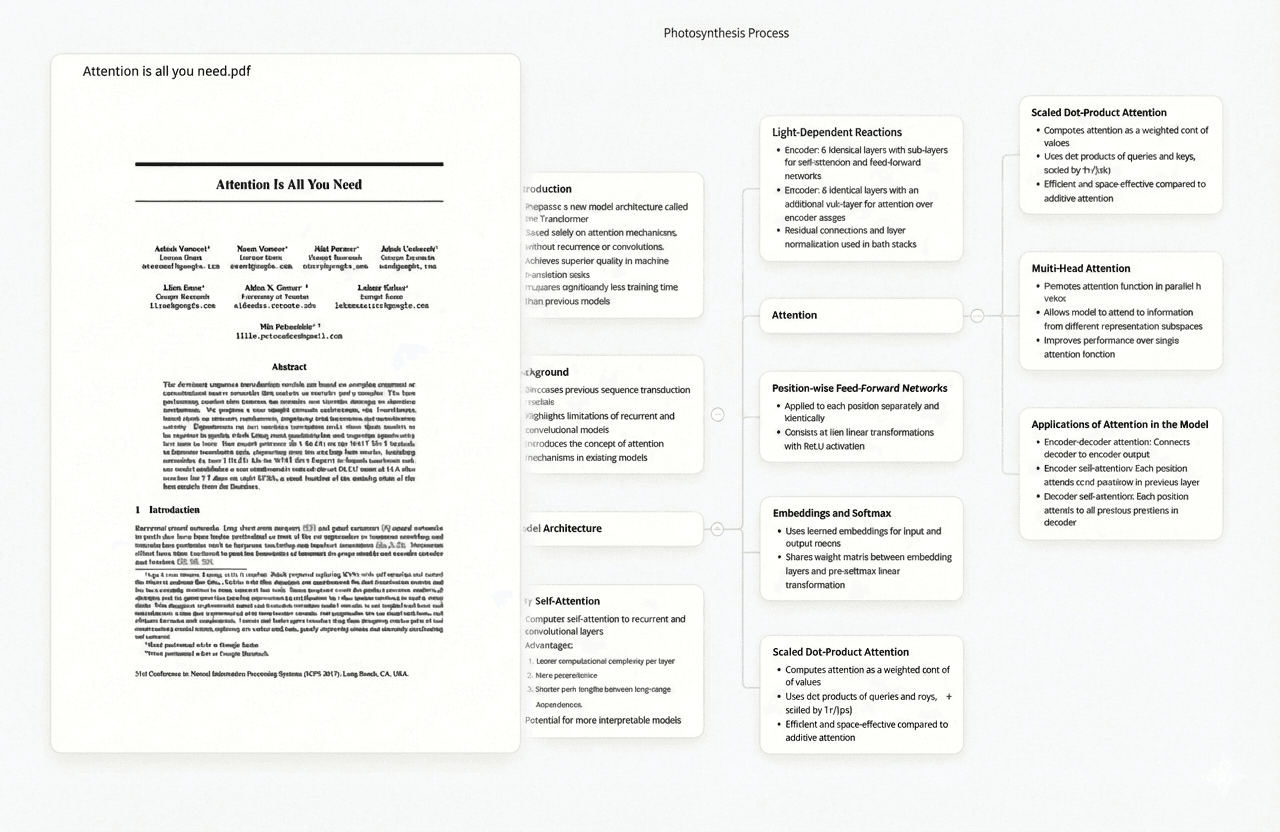
Ponder — When You Need Cross-Document Synthesis, Not Just Research Mapping
IRIS.AI builds structured research maps — it takes a topic and identifies clusters of related papers, helping you see the landscape of a research field. This is useful for scoping a new area, but it does not answer the question that follows: once you know which papers exist, what do they collectively say? Ponder addresses this synthesis step directly. Upload the PDFs you found (through IRIS.AI or any other source, or use Ponder's built-in Academic Search powered by OpenAlex covering 250M+ papers) and ask questions across the entire collection. "What do these studies agree on about the mechanism?" or "Where do these trials conflict on dosage?" — Ponder reads all of them simultaneously and returns an answer with page-level citations pointing to exactly where in each paper the evidence appears.
The difference is between mapping and understanding. IRIS.AI shows you that 200 papers exist on a topic and groups them into clusters. Ponder lets you ask what those 200 papers collectively conclude. For systematic reviews, literature review chapters, and grant background sections, the bottleneck is rarely finding papers — tools like IRIS.AI, Semantic Scholar, and Google Scholar solve that. The bottleneck is reading, comparing, and synthesising what the papers say. Ponder's cross-document Q&A treats your entire paper collection as a single queryable knowledge base, with every claim traceable to a specific page in a specific paper.
Try Ponder for academic research →
- Cross-document synthesis with page-level citations across all uploaded papers
- Academic Search via OpenAlex — 250M+ papers searchable within your workspace
- Upload PDFs from IRIS.AI exports or any other source
- Structured Projects for organising papers by review or research question
- Free tier with 50 credits/day; paid plans from $14/month
Elicit — When You Want AI to Extract Structured Data from Papers Automatically
IRIS.AI maps the research landscape at a high level — showing clusters, gaps, and the overall structure of a field. Elicit works at the paper level: give it a research question and it finds relevant papers, then uses language models to extract specific data points from each one. Study design, sample size, key findings, population characteristics, intervention details — Elicit reads each paper and populates a structured table that you can filter and sort across dozens or hundreds of studies. For systematic reviews where you need to compare specific outcomes across studies, Elicit automates the data extraction workflow that IRIS.AI's high-level mapping does not address.
The practical advantage over IRIS.AI is granularity. IRIS.AI tells you that a cluster of 50 papers exists on a subtopic. Elicit tells you what each of those 50 papers found, in a format you can directly use for evidence tables, forest plots, or narrative synthesis. The trade-off is scope: Elicit is designed for structured analysis of a defined set of papers, while IRIS.AI is designed for exploratory discovery when you are still defining the scope. For researchers who have moved past the exploration phase into systematic analysis, Elicit picks up where IRIS.AI's mapping stops.
- AI-powered data extraction into structured, sortable tables
- Custom columns for any data point across papers
- Semantic search across 125M+ papers with relevance ranking
- Automated abstract and full-text analysis
- Free tier available; Plus plan from $10/month
Semantic Scholar — When You Want AI-Enhanced Paper Discovery Across All Disciplines
IRIS.AI focuses on STEM literature and uses its own classification system to map research topics. Semantic Scholar takes a broader approach: it indexes over 200 million papers across all academic disciplines — including social sciences, humanities, and interdisciplinary venues that IRIS.AI may not fully cover — and applies AI features universally across the database. TLDR summaries give you a single-sentence overview of each paper without opening it. Research Feeds surface new relevant papers automatically based on your reading history. The citation graph shows not just citation counts but semantic relationships between works.
For researchers working across disciplinary boundaries, Semantic Scholar's coverage breadth is the critical advantage. IRIS.AI's mapping works best within a well-defined STEM field where the publication landscape is coherent. When your research question spans, say, computational biology and social determinants of health, or combines engineering methods with educational research, Semantic Scholar's cross-disciplinary index finds connections that a STEM-focused tool may miss. The TLDR summaries also solve a practical triage problem: scanning 100 search results takes minutes instead of hours when each paper has a one-sentence AI summary.
- 200M+ papers across all academic disciplines
- TLDR summaries for rapid paper triage
- AI Research Feeds personalised to your reading patterns
- Semantic Reader with inline citation explanations
- Free public API for programmatic access
- Completely free — no subscription required
ResearchRabbit — When You Want to Discover Papers Through Citation Networks
IRIS.AI maps research by topic clustering. ResearchRabbit maps research by citation relationships — give it seed papers and it builds a visual network of connected works, following citation chains to surface papers that cite your seeds, papers cited by your seeds, and papers with similar citation profiles. The discovery mechanism is fundamentally different: IRIS.AI uses semantic similarity and keyword analysis to group papers, while ResearchRabbit uses the citation graph itself as the discovery signal. Papers that share many citations tend to be related, even if they use different terminology or appear in different venues.
ResearchRabbit's strength is in ongoing, evolving discovery. Add a paper to your collection and the recommendation engine updates — over time, as your library grows, the recommendations become increasingly tailored to your specific research direction. IRIS.AI provides a snapshot of a research landscape at a given moment. For researchers who are building a living collection of relevant literature over months — collecting papers for a dissertation chapter, maintaining awareness in a rapidly evolving field — ResearchRabbit's continuous discovery model is more natural than repeated IRIS.AI mapping sessions. The tool is also completely free with no usage limits.
- Visual citation network exploration from seed papers
- Personalised recommendations that improve as your library grows
- Similar Work, Cited By, and References views for each paper
- Collection-based organisation for managing multiple research threads
- Completely free with no premium tier
Consensus — When You Want Evidence-Based Answers to Research Questions
IRIS.AI gives you a map of a research field. Consensus gives you a direct answer to a research question, backed by evidence from peer-reviewed papers. Ask "Does zinc supplementation reduce the duration of the common cold?" and Consensus searches its database of 200M+ papers, identifies the relevant studies, and provides a synthesised answer with a meter showing the degree of consensus across the evidence. For clinical and health research questions where you need a quick evidence check, Consensus delivers an answer format that IRIS.AI's research mapping does not offer.
This evidence-synthesis approach is most valuable for researchers who need to verify a claim or assess the state of evidence on a specific question — not explore a broad topic. IRIS.AI excels at showing the structure of a research field: what subtopics exist, how they relate, where there are gaps. Consensus excels at answering pointed questions within that field. In practice, you might use IRIS.AI to explore a new area and identify the key questions, then use Consensus to quickly check what the evidence says about each question. The two tools address different phases of the research process rather than competing directly.
- AI-synthesised answers from 200M+ peer-reviewed papers
- Consensus Meter shows the degree of agreement across studies
- Natural language questions — no boolean operators needed
- Study Snapshots with key findings extracted from each paper
- Free tier available; Pro plan for advanced features
Undermind — When You Need Deep Literature Search with Reasoning
Most academic search tools, including IRIS.AI's mapping function, work by matching keywords or semantic similarity — they find papers that contain the words you searched for or that are topically similar to your seed papers. Undermind takes a different approach: it searches iteratively, reading abstracts and reasoning about relevance, then refining its search based on what it learns from initial results. This reasoning-based search uncovers papers that a keyword or topic-matching approach would miss — papers that use different terminology, approach the question from an unexpected angle, or sit at the intersection of fields that are not usually connected.
This matters most for interdisciplinary research questions or novel research directions where the relevant literature is scattered across fields. A search for "machine learning applications in protein folding" on IRIS.AI produces a clean cluster of papers in that well-defined space. But a search for "computational methods that might apply to understanding how proteins misfolding causes disease progression" requires understanding the question, not just matching keywords — and that is where Undermind's reasoning-based search finds papers that traditional tools miss. The trade-off is speed: Undermind's deep search takes minutes rather than seconds, and the results require verification because AI reasoning can make unexpected connections.
- Reasoning-based search that understands research questions, not just keywords
- Iterative refinement — learns from initial results to improve subsequent searches
- Finds papers across disciplinary boundaries using conceptual reasoning
- Detailed explanations of why each paper was selected
- Subscription-based; positioned for researchers with complex search needs
Scite — When You Need to Know How Papers Cite Each Other
IRIS.AI maps whether papers are related by topic. Scite maps how papers relate through citations — specifically, whether citing papers support, contradict, or merely mention the cited work. This citation context analysis, called Smart Citations, provides a dimension of information that IRIS.AI's topic mapping and standard citation counts both miss. A paper with 500 citations looks authoritative, but if 80 of those citations present contradicting evidence, the picture changes fundamentally. Scite surfaces this signal by classifying each citation in its database by the context in which it appears.
For researchers assessing the strength of evidence behind a finding — particularly in systematic reviews, meta-analyses, or grant applications where the reliability of cited evidence matters — scite provides quality signals that discovery and mapping tools cannot. You might use IRIS.AI to find the key papers in a field, then use scite to assess which of those papers have strong supporting evidence and which have been challenged by subsequent work. The Reference Check feature can also scan your own manuscript and flag any citations that have been retracted or significantly contradicted since publication — a quality assurance step that catches errors before peer review.
- Smart Citations classify each citation as supporting, contrasting, or mentioning
- Citation dashboards showing evidence strength for any paper
- Reference Check scans manuscripts for retracted or contradicted citations
- Browser extension shows citation context on publisher websites
- Institutional and individual subscription plans
Frequently asked questions
Is IRIS.AI free to use?
IRIS.AI offers a free tier with limited functionality, including basic research space exploration and a restricted number of paper analyses per month. The full platform, including unlimited research maps, advanced filtering, and team collaboration features, requires a paid subscription. Pricing is typically institutional or team-based rather than individual. For researchers who need free alternatives for paper discovery, Semantic Scholar, ResearchRabbit, and Ponder's free tier (50 credits/day) all offer substantial functionality without cost. Connected Papers provides five free graphs per month for visual citation mapping.
What is IRIS.AI best used for?
IRIS.AI is most useful in the early exploration phase of research — when you are entering a new field or topic and need to understand the landscape: what subtopics exist, how they relate to each other, where the research clusters are, and where there might be gaps. Its research mapping feature creates a visual overview that is difficult to build manually from search results. IRIS.AI is less suited for the later phases of research — detailed analysis of individual papers (where Elicit excels), evidence synthesis across a collection (where Ponder excels), or ongoing paper discovery (where ResearchRabbit excels).
Can IRIS.AI replace a systematic literature search?
No. IRIS.AI can supplement a systematic literature search by helping identify relevant topic areas and papers that keyword-based searching might miss, but it does not meet the requirements for a reproducible systematic search strategy. Systematic reviews require documented, reproducible searches across multiple databases using boolean operators, controlled vocabulary, and transparent inclusion criteria. IRIS.AI's mapping algorithm is not reproducible in the way that a PubMed or Scopus search strategy is. For systematic reviews, use IRIS.AI as an exploratory supplement alongside structured searches in PubMed, Scopus, and Web of Science.
What is the difference between IRIS.AI and ResearchRabbit?
IRIS.AI maps research by topic similarity — it analyses keywords, abstracts, and semantic content to group papers into clusters and visualise the structure of a research field. ResearchRabbit maps research by citation relationships — it follows citation chains from seed papers to build a network of connected works. IRIS.AI is better for understanding the overall landscape of a field you are new to. ResearchRabbit is better for building a personal library of relevant papers over time, starting from papers you already know are relevant. Both are discovery tools; neither provides synthesis, data extraction, or citation context analysis.
See also: Best AI Research Tools for Students | How to Summarize Research Papers with AI | How to Write a Literature Review with AI | Connected Papers Alternatives