

Llama 4 vs. GPT-4o: Comprehensive AI Model Comparison for Researchers and Analysts
 ·7/14/2026·11 min read
The rapid evolution of artificial intelligence has led to the emergence of advanced models like Llama 4 and GPT-4o, each offering unique capabilities and architectural frameworks. This article provides a detailed comparison of these two models, focusing on their core differences, multimodal capabilities, performance benchmarks, cost efficiency, licensing implications, and ethical considerations. Readers will gain insights into how these models can be leveraged for various applications, particularly in research and analysis. As AI continues to shape industries, understanding the nuances between Llama 4 and GPT-4o is essential for making informed decisions about their use. We will explore the architectural differences, performance metrics, and ethical implications, providing a comprehensive overview of both models.
Quick answer: For most research and knowledge work applications, GPT-4o and Llama 4 are both highly capable but serve different deployment needs. GPT-4o excels at multimodal tasks and integrates natively with OpenAI's tool ecosystem. Llama 4 is the stronger open-source choice for self-hosted, privacy-first deployments. For researchers and knowledge workers, the model choice matters less than the tool built on top: Ponder's knowledge canvas combines AI synthesis across your entire source library — and works with multiple model backends.
What Are the Core Architectural Differences Between Llama 4 and GPT-4o?
The architectural frameworks of Llama 4 and GPT‑4o strongly influence their capabilities and deployment tradeoffs. Llama 4 is an open‑weights model family released under Meta’s license terms, with variants that may differ by size, modality support, and serving characteristics. Some variants are described as using Mixture‑of‑Experts (MoE) techniques to improve throughput/efficiency—confirm the architecture of the exact checkpoint you plan to use. GPT‑4o, by contrast, is positioned as an end‑to‑end “omni” model designed to handle multiple modalities within a unified system. This design enables it to process diverse data types seamlessly, enhancing its versatility across applications.
How Does Llama 4's Mixture-of-Experts Architecture Enhance Efficiency?
In MoE architectures, only a subset of ‘experts’ is activated per token, which can improve inference efficiency versus activating the full model every step. If you’re evaluating a specific Llama 4 checkpoint, verify whether it is MoE or dense, and review its routing/serving requirements before making throughput and cost assumptions. Use cases demonstrating its efficiency include natural language processing tasks where quick turnaround times are critical.
What Defines GPT-4o's End-to-End Omni-Model Training Approach?
GPT‑4o is positioned as an ‘omni’ multimodal model designed to handle text and vision, and (in supported products/APIs) audio in a more unified workflow than traditional ‘bolt‑on’ multimodal systems. Exact modality support and latency depend on the specific OpenAI product endpoint. This comprehensive training methodology enhances the model's ability to generalize across different tasks, making it particularly effective in multimodal applications. The benefits of this approach include improved performance metrics and the ability to adapt to new types of data without extensive retraining. For example, GPT-4o excels in tasks that require understanding both text and visual inputs, showcasing its robust training framework.
How Do Llama 4 and GPT-4o Compare in Multimodal AI Capabilities?
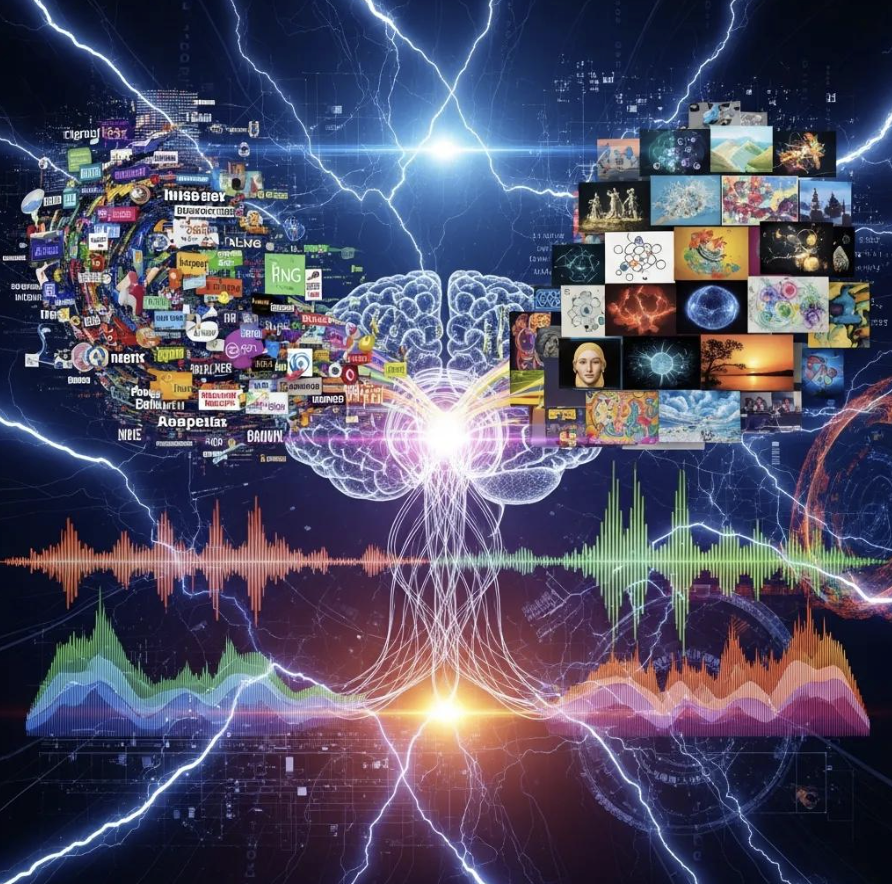
Multimodal AI capabilities via AI tool visualize PDF connections are increasingly important as applications demand the integration of various data types. Llama 4 supports a range of multimodal inputs, including text and images, allowing it to perform tasks that require understanding context from multiple sources. This capability is particularly beneficial in research settings where data is often presented in diverse formats.
What Multimodal Inputs Does Llama 4 Support?
Depending on the variant and the tooling you use, Llama‑family multimodal setups can support text + images via YouTube-to-mind-map AI, extended to video via frame sampling pipelines. This versatility enables researchers to utilize the model for tasks such as image captioning and data analysis, where insights can be drawn from both visual and textual information. The ability to handle multiple input types enhances its applicability in fields like data science and content creation, where diverse data formats are common.
How Does GPT-4o Handle Text, Audio, Image, and Video Modalities?
GPT‑4o supports text and image understanding/generation, and—where enabled—audio input/output. Video via convert video lecture to knowledge graph frame extraction + prompting, and you should validate the current API capabilities (modalities, limits, response formats) before committing to a production design. For production decisions, teams should validate current modality support, latency, and output formats directly against the latest vendor documentation. This comprehensive support allows it to perform complex tasks such as generating descriptive text for images or transcribing audio into written format. The model's ability to integrate these modalities makes it particularly valuable in industries like media and entertainment, where content is often produced in various formats. Real-world applications include automated video editing and content generation for multimedia platforms.
Independent write-ups and vendor materials describe GPT‑4o as a strong multimodal model, particularly for fast interactive experiences and cross‑modal understanding (text + vision + audio). If you cite third‑party research, ensure references are fully verifiable (author full name, title, venue, year, and a working link/DOI) and avoid absolute claims like “state‑of‑the‑art” unless the evidence is clearly documented.
For those interested in deeper dives into AI model capabilities and their practical applications, the Ponder blog provides a wealth of articles and research.
What Are the Performance Benchmarks of Llama 4 Versus GPT-4o?
Performance benchmarks are critical for evaluating the effectiveness of AI models in real-world applications. Llama 4 and GPT-4o have been subjected to various performance tests, revealing their strengths and weaknesses across different tasks. Understanding via AI tool visualizing citation networks helps researchers and analysts select the appropriate model for their specific needs.
How Does Llama 4 Maverick Perform on Coding and Reasoning Benchmarks?
Public discussions sometimes report strong performance for certain Llama 4 variants on coding and reasoning benchmarks (e.g., LiveCodeBench, GPQA). For a publishable, researcher-friendly statement, frame it like this:
Llama 4 performance may be competitive on coding and reasoning for certain variants and evaluation settings.
The most responsible recommendation is to run a small internal eval that matches your use case: your languages, your codebase style, your rubric, and your constraints (latency/cost).
What Are GPT-4o's Strengths Across MMLU, HumanEval, and Multilingual Tests?
GPT‑4o is commonly evaluated on benchmarks such as MMLU and HumanEval, and is often used in multilingual settings due to strong general instruction-following and cross-lingual behavior. For rigorous comparison, record the exact model version, evaluation harness, temperature, and whether tools/function calling were enabled.
How Do Cost and Resource Efficiency Differ Between Llama 4 and GPT-4o?
Cost and resource efficiency are crucial considerations when selecting an AI model for deployment. Llama 4 and GPT-4o differ significantly in their pricing models and resource requirements, impacting their accessibility for various users.
What Is the Pricing Model and Cost Per Token for Llama 4?
Llama 4 is typically accessed via self‑hosting (you control GPU/CPU costs) or third‑party APIs (provider pricing varies). To estimate total cost of ownership, compare: GPU hours, tokens/sec throughput, batching efficiency, memory footprint, and engineering/ops overhead—not just ‘$/token’.
How Does GPT-4o's Pay-Per-Use API Pricing Affect Scalability?
GPT-4o employs a pay-per-use API pricing model, which can significantly impact scalability for users. This model allows organizations to pay only for the resources they consume, making it an attractive option for businesses with fluctuating demands.Pay‑per‑use pricing scales cleanly for prototypes and variable workloads, but costs can spike with high-volume generation, long contexts, or multimodal inputs. For budgeting, set rate limits, log tokens by feature, and run a representative workload benchmark before launch.
Ponder, an AI-powered knowledge workspace, offers tools that can help researchers and analysts manage their projects efficiently. By integrating both Llama 4 and GPT-4o into their workflows, users can leverage the strengths of each model while maintaining cost efficiency.
What Are the Implications of Open-Source Versus Proprietary Models in Llama 4 and GPT-4o?
The choice between open‑weight and proprietary models affects customization, deployment, and data governance. Llama 4 is distributed as open weights under Meta’s license terms, which may allow commercial use but can include restrictions depending on the specific release. Teams should review the exact license text before deploying, redistributing, or fine‑tuning in production.
How Do Llama 4’s Open‑Weights License Terms Enable Customization?
Because Llama 4 is distributed as open weights under Meta’s license terms, teams may be able to fine‑tune, evaluate, and deploy it with more control than a purely hosted model—subject to the specific license conditions of the release. Review the license before commercial deployment or redistribution.
What Are the Deployment and Data Privacy Considerations for GPT-4o?
GPT-4o's proprietary model raises important deployment and data privacy considerations. Organizations using GPT-4o must navigate the complexities of data handling and compliance with privacy regulations. The proprietary nature of the model may limit customization options, making it essential for users to carefully evaluate their data management strategies. Understanding these implications is crucial for organizations seeking to implement GPT-4o responsibly.
What Ethical and Safety Features Differentiate Llama 4 and GPT-4o?
Ethical considerations are paramount in the development and deployment of AI models. Llama 4 and GPT-4o incorporate various ethical and safety features to address concerns related to bias, transparency, and user safety.

How Does Llama 4 Address Bias Mitigation and Content Moderation?
Llama 4 incorporates several strategies for bias mitigation and content moderation, aimed at reducing biased or unsafe outputs, though no model can guarantee unbiased behavior across all contexts. Teams should implement evaluation sets, red-teaming, and domain-specific safety checks for their use case. These strategies include diverse training data and ongoing monitoring of model performance to identify and rectify potential biases. By prioritizing ethical considerations, Llama 4 aims to foster trust and reliability in its applications.
What Safety Protocols and Transparency Measures Are Implemented in GPT-4o?
GPT-4o implements robust safety protocols and transparency measures to safeguard users and ensure responsible AI usage. In practice, safe deployment depends on product policies, content filtering options, audit logging, and internal review workflows. Organizations should also evaluate data retention, privacy controls, and compliance requirements based on the endpoint they use.
Model | Architecture (high level) | Key Features | Cost model |
|---|---|---|---|
Llama 4 | Variant-dependent (dense and/or MoE depending on checkpoint) | Open weights, flexible deployment, can be fine-tuned | Self-host TCO or provider-specific API pricing |
GPT‑4o | Proprietary multimodal “omni” model (product-dependent modality support) | Strong interactive multimodal UX, hosted reliability | Pay‑per‑use API pricing |
This comparison highlights the distinct architectural approaches and cost structures of Llama 4 and GPT-4o, providing insights into their respective strengths and weaknesses.
Bring This Into a Research Workflow (Ponder)
If you’re actively comparing models—tracking prompts, saving outputs, and building a repeatable evaluation process—an AI research workspace helps you keep everything organized and reproducible.
Ponder, an AI-powered knowledge workspace, is designed for researchers and analysts to run deeper investigations, compare sources, and turn experiments into reusable knowledge.
Ready to explore and streamline multi-model evaluation? You can sign up for Ponder today.
Try Ponder for academic research →
FAQ
1.Which model should I choose for academic research and literature review workflows?
If your day-to-day work is paper triage, summarization, synthesis, and structured note-taking, the deciding factors are usually data governance, budget predictability, and whether you frequently need to interpret figures/tables. Llama 4 is typically the better fit when you need tighter control (for example, self-hosting, internal reproducibility requirements, or stricter privacy constraints), while GPT-4o is often the smoother choice when you want fast iteration, strong general-purpose reasoning and writing quality, and straightforward multimodal handling through a managed API—just be sure your compliance posture matches the deployment model.
2. Can I use Llama 4 and GPT-4o together in one evaluation workflow?
Yes, and that’s often the most practical approach for researchers and analysts because the two models can complement each other across cost, speed, and governance needs. A common pattern is to run broad exploration and rapid multimodal analysis with GPT-4o, then validate, stress-test, or reproduce key findings with Llama 4 in a more controlled environment (or when you want to lock down data and infrastructure), while keeping prompts, outputs, and conclusions organized in one place for auditability and comparison.
3. What should I cite or report to make benchmark claims credible in my write-up?
To keep your comparison publishable and defensible, treat benchmark numbers as context rather than absolute truth and always specify the evaluation setup that produced them. When you mention results like MMLU, HumanEval, LiveCodeBench, or GPQA, include the dataset/version (if known), prompting style, tool use, temperature/sampling settings, and whether results come from vendor materials, independent reports, or your own tests; this prevents “state-of-the-art” style overclaims and makes your conclusions reproducible for readers who want to validate them.
Frequently asked questions
What is the main difference between Llama 4 and GPT-4o?
Llama 4 and GPT-4o differ fundamentally in their deployment model. GPT-4o (OpenAI): closed-source API and ChatGPT product — you pay per token or subscription, OpenAI runs the infrastructure, no ability to inspect or modify model weights. Llama 4 (Meta): open-weights model released under a commercial license — you can download the weights, run on your own hardware, fine-tune on your own data, and deploy without per-token fees. In capability: GPT-4o generally outperforms Llama 4 on standard benchmarks, particularly for complex reasoning and instruction following. But Llama 4 at the same scale approaches GPT-4o class performance, and its open-weights nature gives organizations control, customizability, and privacy that GPT-4o can't match.
Which is better for research — Llama 4 or GPT-4o?
For most research use cases, GPT-4o performs better out of the box: stronger instruction following, document analysis, and synthesis. The gap matters for complex multi-step research tasks. Llama 4 is better for research when: you need to self-host for data privacy (clinical/legal/proprietary research), fine-tune on domain-specific literature, deploy at scale without API cost concerns, or want transparency about the model's behavior. Research institutions with infrastructure (university HPC, cloud credits) increasingly use Llama or its derivatives for specialized research tasks. Commercial researchers and students without privacy concerns will generally get better results faster with GPT-4o via ChatGPT or API.
Can Llama 4 run locally on a laptop?
Llama 4's full models require substantial GPU memory — not typically practical on consumer laptops for the largest variants. However: Quantized versions (4-bit, 8-bit) of Llama 4 Scout and smaller variants run on mid-range hardware (16-24GB VRAM, or CPU with 32GB+ RAM through llama.cpp); Tools like Ollama and LM Studio make local Llama deployment accessible — download the app, pull the model, run it without any cloud dependency; Apple Silicon Macs (M2/M3 Pro with 16-32GB unified memory) run quantized Llama 4 models reasonably well. The trade-off: local Llama is private and free but slower than API calls and requires hardware investment. For privacy-sensitive research documents, local models are often worth the performance cost.
Is GPT-4o free to use?
GPT-4o is available on the free tier of ChatGPT with rate limits — free users access GPT-4o with daily message limits. ChatGPT Plus ($20/month) removes most rate limits and provides priority access. The GPT-4o API (for developers building applications) charges per token with no free tier beyond a small trial credit. For researchers and students who want GPT-4o capabilities without paying: the free ChatGPT tier covers moderate daily use. For heavy use (extensive document analysis, batch processing), the API or a Plus subscription becomes practical. Alternatives: Claude.ai (Anthropic) has a comparable free tier with similar capabilities; Google Gemini (free) is also GPT-4o class.
What are the best use cases for Llama 4 vs GPT-4o?
Choose Llama 4 when: data privacy is essential (healthcare, legal, proprietary research — you need the model on your own servers); you need fine-tuning on specialized data; you want reproducible, auditable model behavior; you're building a research tool or product and need cost control at scale. Choose GPT-4o when: you want the highest general performance with minimal setup; you need strong plugin/tool ecosystems (Bing Search integration, DALL-E image generation, code interpreter); you're using ChatGPT directly rather than through API; you need the latest multimodal capabilities. For most researchers using AI as a writing assistant, document Q&A, or search synthesis tool, GPT-4o through ChatGPT is the path of least resistance. Llama 4's value is primarily for technically capable teams deploying AI privately at scale.
See also: Best AI Tools for Data Analysis | Best AI Research Tools for Students | Best AI Tools for Literature Review | NotebookLM Alternatives