

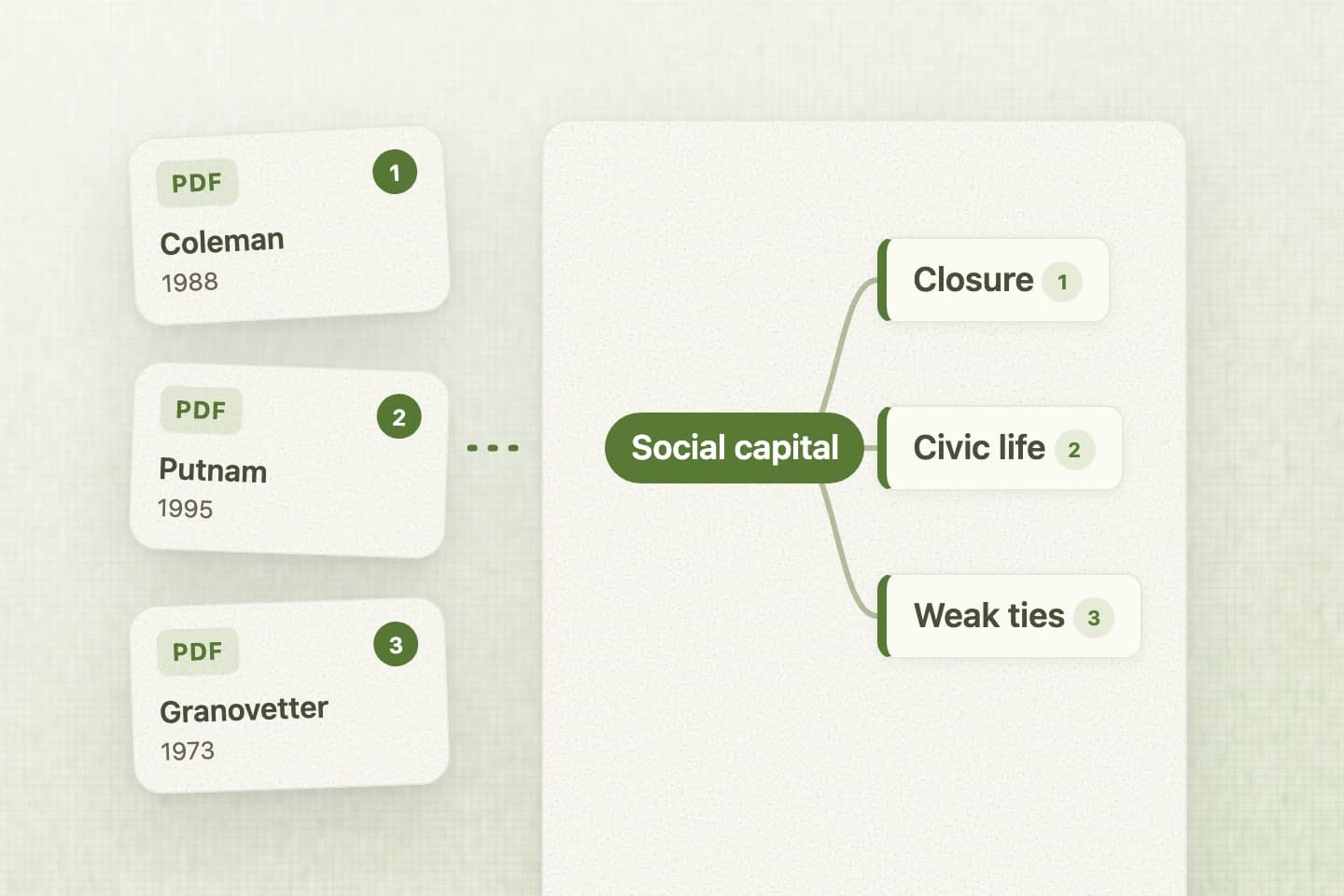
The useful comparison is not which interface has more AI buttons. It is where the source boundary lives, what the researcher can inspect, and which artifact remains after the answer. Ponder and NotebookLM can both assist research, but they organize the work differently.
Short answer: Choose Ponder when you need an academic workflow from scholarly search to cited drafting. Choose NotebookLM when the immediate priority is source-grounded exploration and media-style outputs.
Compare the output after the sources are explored
| Decision axis | Ponder | NotebookLM |
|---|---|---|
| Primary scope | A persistent research project built from selected sources | NotebookLM's own reading, search, or general-assistant workflow |
| Best question | How do these sources compare, connect, and support a draft? | What can NotebookLM explain, retrieve, or generate for this immediate task? |
| Core output | Editable mind map, notes, cross-source answers, and cited writing | Tool-specific summaries, answers, or generated text |
| Source handling | Project files, scholarly search, DOI and web-source intake | NotebookLM's supported source and conversation model |
| Decision trigger | Source conversations are useful but the next deliverable needs editable research structure and academic writing continuity | Source-grounded exploration and media-style outputs is the immediate deliverable |
Where NotebookLM excels at source exploration
NotebookLM is a source-grounded notebook for exploring uploaded material and creating outputs such as conversational summaries and Audio Overviews. It is compelling when the goal is to engage with a bounded set of sources in several formats.
Where Ponder carries the work into academic production
Ponder adds scholarly search and an explicit path from selected sources to cross-source comparison, editable mind maps and notes, and cited drafting. The researcher can revise the interpretation and structure before the accepted result enters writing, while preserving the route back to source context.
Choose NotebookLM when source-grounded exploration and generated media are the primary outputs. Choose Ponder when the project requires an editable research structure and a direct handoff into cited academic writing. The useful trial begins after the first good answer: test how each product supports revision and the next scholarly artifact.
Source-grounded conversation and academic production are not identical
NotebookLM is strong for exploring a supplied source set and producing useful source-grounded outputs. Ponder is the better fit when that exploration must connect to scholarly search, an editable research structure, and cited academic drafting.
A graduate researcher may enjoy a clear source conversation and still face the blank-page problem afterward. In Ponder, the same papers can be compared with @, organized in an editable mind map or note, and carried into Draft. The structure remains available when the argument is revised.
Build the literature-review artifact, then change it
Use the same sources in both tools and require a chapter structure, not a summary. Add one source that forces a branch to split. In NotebookLM, evaluate the source-grounded exploration and the outputs most relevant to your task. In Ponder, evaluate whether the revised map, supporting citations, and cited prose form one continuous academic workflow.
Choose NotebookLM when source exploration or its distinctive generated formats are the desired endpoint. Choose Ponder when the endpoint is a research argument that must be edited and written with citations. Researchers should try Ponder when they are tired of translating a useful notebook conversation into a separate outline and manuscript.
Questions about the two source-grounded workflows
Does Ponder also help find scholarly papers?
Yes. Ponder connects scholarly search with the selected-source project, comparison, editable structure, and writing path.
What should decide the trial?
Require the final artifact you actually need, then revise it. The winner is the workflow that survives the revision with the least loss of evidence context.