

Responsible AI and limitations
The safeguards behind Ponder, and its limitations today.
We want Ponder to save you time without asking you to compromise on trustworthiness. This article explains how Ponder uses AI and the safeguards built around it, and sets out the current limitations frankly, so you can judge how far to rely on it.
How Ponder uses AI
Search first, synthesize after.
When you ask a research question, Ponder first searches academic databases for real papers, then has AI read, analyze and synthesize them. The same holds when you import your own material: the AI reads the files you put in the project, and mind maps, notes and manuscripts all build on those sources; where the material is not enough, Ponder searches the literature to fill the gap, and papers found that way are attributed too.
What AI does in Ponder is help you understand the research you have already found, faster.
Safeguards
The papers are real records: a search review is written from the papers found in that round, and every one of them comes from a real record in an academic database.
Every claim is attributed: each numbered marker in a review corresponds to a paper in the list. Hover over a marker to see the paper's title, and click it to open that paper's detail.
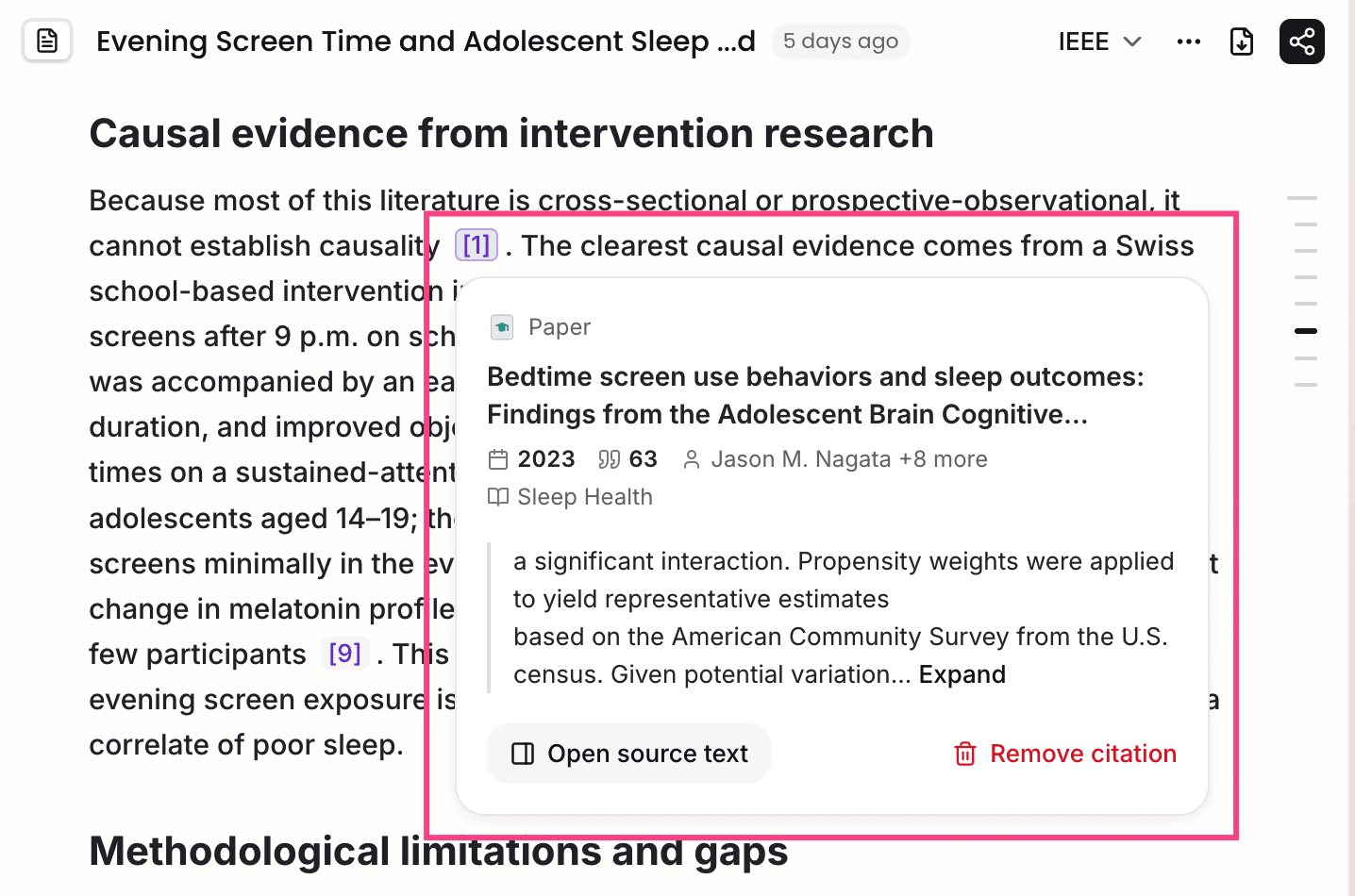
Citations carry the source text: when a manuscript cites a paper with a full text, Ponder also records the passage it worked from. Open the citation in the text and the card shows that passage; click Open source text and the paper opens in the column alongside, located at that passage.
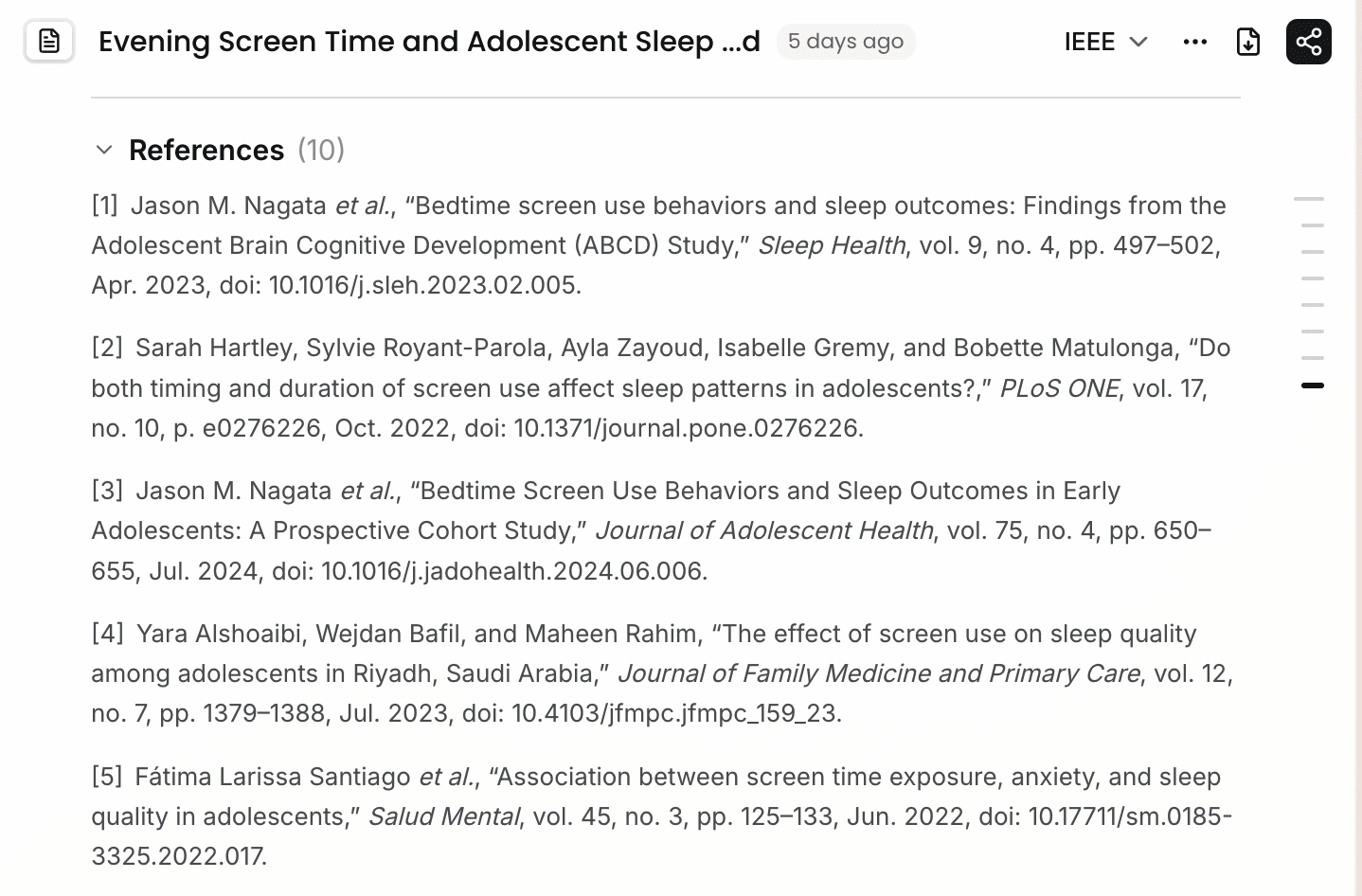
The reference list comes from bibliographic data: the references at the end are built from each paper's bibliographic data in the citation style you chose, with authors, year and journal name taken from the paper's record.
Retraction badges: retracted papers carry a "Retracted" badge in search results and in the reference list.
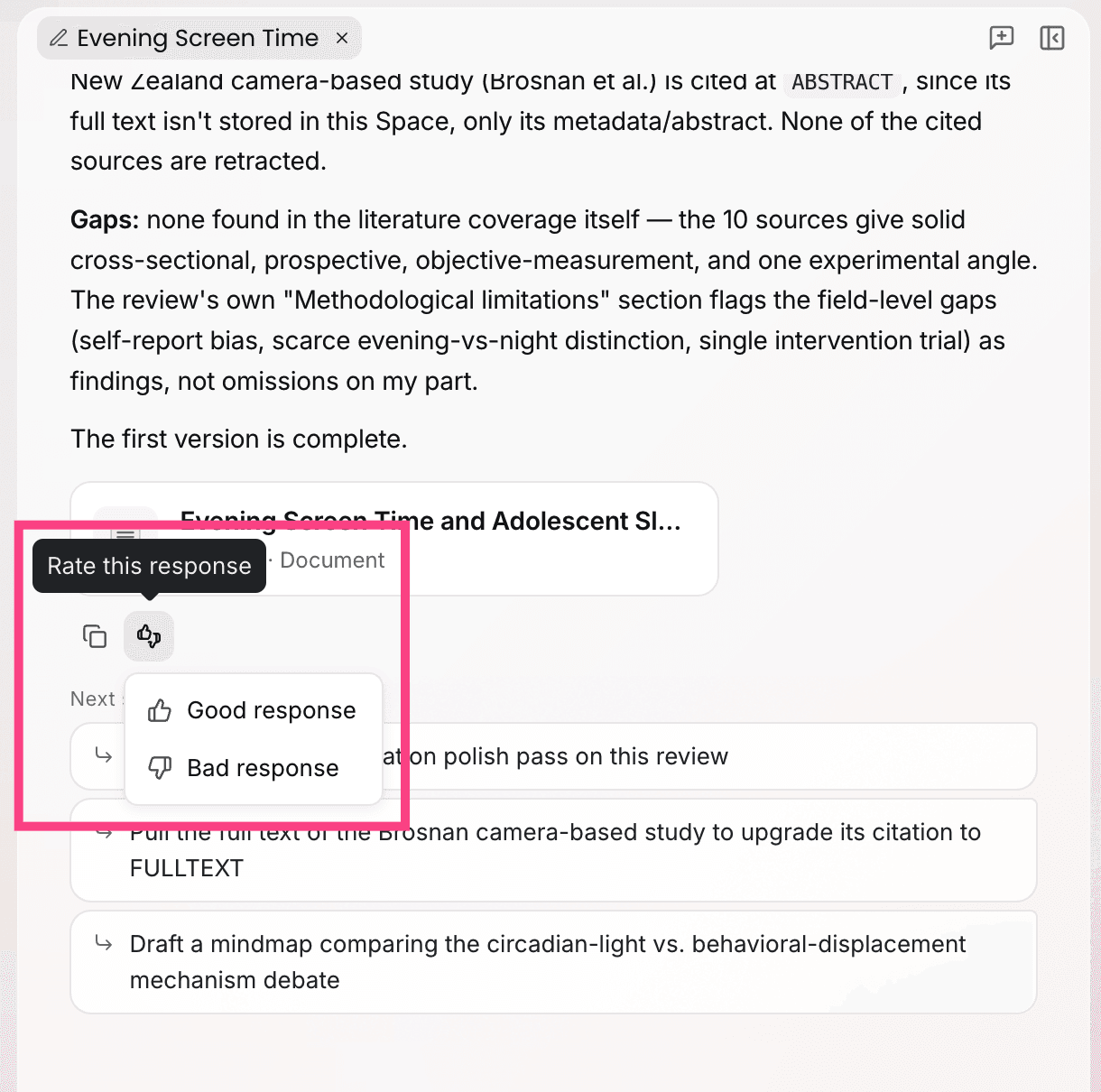
A way to tell us: when you see something inaccurate, tell us through Rate this response at the end of each turn in a conversation, or write to info@ponder.ing.
Ponder is there to strengthen your research process, not to replace it. Our goal is to get you to reliable evidence faster while keeping the original research behind that evidence visible and one click away.
Limitations
AI and academic search tools both have limits. Ponder makes finding and reading literature much faster, and the sources that matter are still worth evaluating yourself.
For paywalled papers, Ponder reads the abstract
Ponder searches the standard academic databases: OpenAlex, PubMed and Semantic Scholar, more than 200 million records across every discipline (see Where the papers come from). Finding a paper and reading its full text are two different things: for open-access papers Ponder can read the full text, and for papers behind a subscription or paywall it has the abstract and bibliographic data.
Ponder marks this. When papers are handed to Analyze or Draft, the abstract-only ones carry an "Abstract only" badge, so you always know whether a passage rests on a full text or on an abstract.
For papers you have access to through your school or institution, upload the PDF into the project and Ponder can read the full text: click Upload PDF next to the paper in the preparation window, or put it straight into the project as described in Import your sources.
AI can misread a paper
The mistakes AI tools make with literature usually fall into three kinds: inventing papers that do not exist; producing claims from the model's own memory with no source; and getting a real paper's content wrong in the retelling.
The way Ponder works makes the first two hard to happen. Every paper found is a real record in a database, and every sentence with a citation marker points at a source you can open.
The third remains possible: AI sometimes misreads a paper or summarizes it imprecisely. That is why we put the source excerpt directly into the citation card, so checking one citation takes a single click. For any claim you plan to cite, open its source and read it against the original.
This is also the best way to use Ponder: treat reviews and mind maps as the way into the literature, then follow the citations back into the original research and read deeply there. That is where real understanding happens.
Finally
We want every researcher to reach reliable evidence faster. Ponder will keep adding safeguards, and will stay transparent about the limits of this technology.
Please do open the sources and check, and tell us where something is inaccurate. Your feedback makes Ponder more accurate for every researcher. Thank you for using Ponder.
What to read next
- To see what Ponder works from: read What is Ponder
- To check and organize the citations in a manuscript: read Citations and tracing claims
- To see how your data is stored and protected: read Your data and privacy