

How to ask a good question
Turn an idea into a question that finds well, and adjust when it does not.
There is no single right way to ask Ponder a question — a full sentence and keywords both work. There is only one requirement: keep your research question at the center of it.
Ask in any language you like; the language does not affect the search — asking in Chinese still finds English papers.
The three techniques below each go a step further than the last, and each comes with a question you can paste in directly.
1. Start from a clear question
Write your idea as one complete question. A question carries the relationship between variables, and Ponder uses it to judge which papers actually answer you.
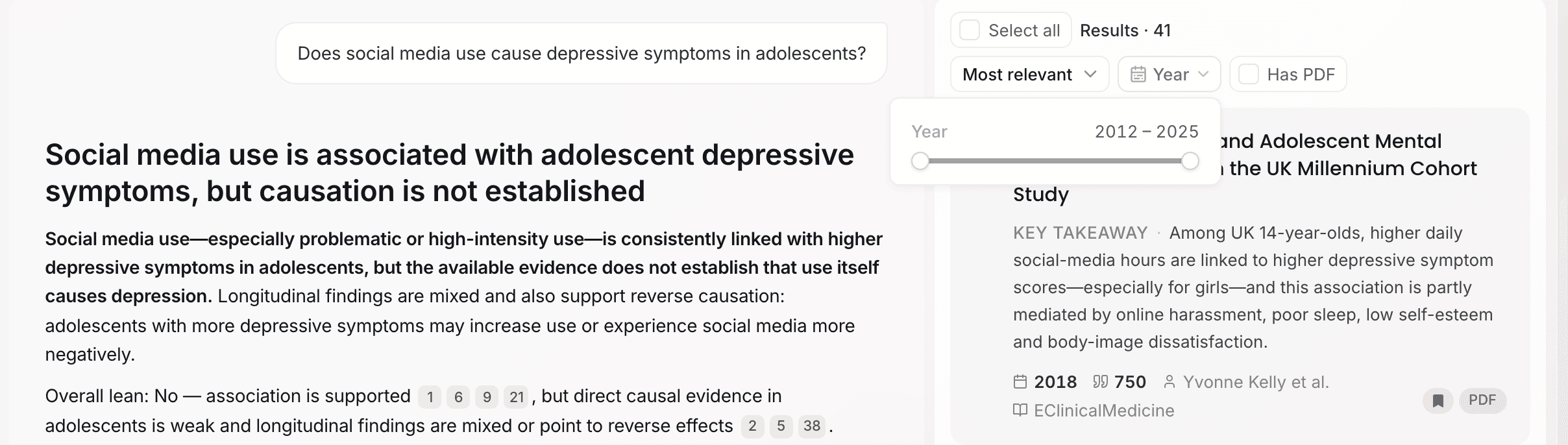
Try: "Does social media use cause depressive symptoms in adolescents?"
If you are not sure how to phrase it, look at Open question, Yes-or-no question and Specify study type below the input box. Open one, pick an example to fill the input box, then edit it into your own question and send.
2. Put your conditions into the question
When you only want one kind of study, write the condition straight into the front of the question: study design, population, sample.
Try: "Longitudinal studies only: does time spent on social media predict adolescents' depressive symptoms one year later?"
Year ranges are set in the Year filter above the results list.
3. Ask another round from the results
The first round of results is the starting point for your next question. Keep asking in the input box at the bottom of the results page, and Ponder either answers from this round's papers or runs another search.
Try: "Which of these studies distinguish active posting from passive browsing?"
Adjusting when the results are not right
| What you are seeing | How to adjust |
|---|---|
| The results are unrelated, or fixate on one word in your question | Widen the question: drop the narrow qualifiers and use more standard academic wording |
| Plenty of related papers, but none hits the question squarely | Narrow the question: state the population, the study design or the specific outcome measure |
| Nothing found at all | A "Did you mean to search:" suggestion appears where the results would be; click one to search again with that phrasing |
| A medical question returns results from other disciplines | Switch the scope at the bottom left of the input box from All to PubMed |
Two comparisons
Rather than "social media depression adolescents", ask "Does social media use cause depressive symptoms in adolescents?"
Rather than "mindfulness effects", ask "Can mindfulness training reduce test anxiety in university students?"
What to read next
- How to filter, follow up and save once you have results: read Filter and follow up: go deeper from your results
- To walk the whole search flow from the start: read Find the most relevant, usable papers