

Understand the literature: mind maps and notes
Use mind maps and notes to read deeply, keep asking, and return to the source.
Finding the literature is only the start; the time goes into understanding it: what one paper actually argues, how several papers relate, how research in a field has unfolded.
The Analyze step does this with you. Ponder reads the material you select and organizes its understanding into two results you can keep working with: mind maps and notes. Both are saved as files in the project, both can be followed up on, and everything in them can be traced back to the source.
Generating mind maps and notes uses credits; for the rules see Plans and credits.
When a mind map fits, and when notes fit
| Mind map | Notes | |
|---|---|---|
| What it gives you | Structure and relationships: the whole picture at a glance, then drill into the branch you care about | Continuous prose: the argument laid out from start to finish |
| When it fits | A long paper whose argument you want to grasp in outline first | A close read of one paper's methods and argument |
| A few papers whose design, conclusions and disagreements you want side by side | Prose material for a lab meeting, a reading report or your writing | |
| A field you are new to, where you want to see how the research unfolded | Reading straight through at your own pace |
Which one to pick also depends on how you read: if you like the whole picture before the detail, use a mind map; if you read linearly, use notes. You can generate both from the same material — the map to navigate, the notes to read closely.
Take the topic "social media use and adolescent depression": generate one mind map from the three longitudinal studies saved during Search, and follow the "study design" branch to compare their samples, follow-up lengths and measurement instruments side by side; then generate notes on the one whose conclusion diverges most, and read its argument closely.
Follow up: keep going from wherever you are
Understanding a paper comes from asking one question after another. Mind maps and notes are not the end point — wherever you are reading, you can ask from there.
- On a mind map: select a node and use Ask AI to ask about that node, Dive In to have Ponder expand one level further, and Explain to have a difficult concept spelled out. The new content attaches below that node, and the map grows with your reading.
- In notes: select a passage and N lines selected appears above the conversation's input box; anything you ask then applies to that passage alone.
Tracing: every point leads back to the source
Content in mind maps and notes carries citations. Open a citation to see the passage it rests on, located in the source text.
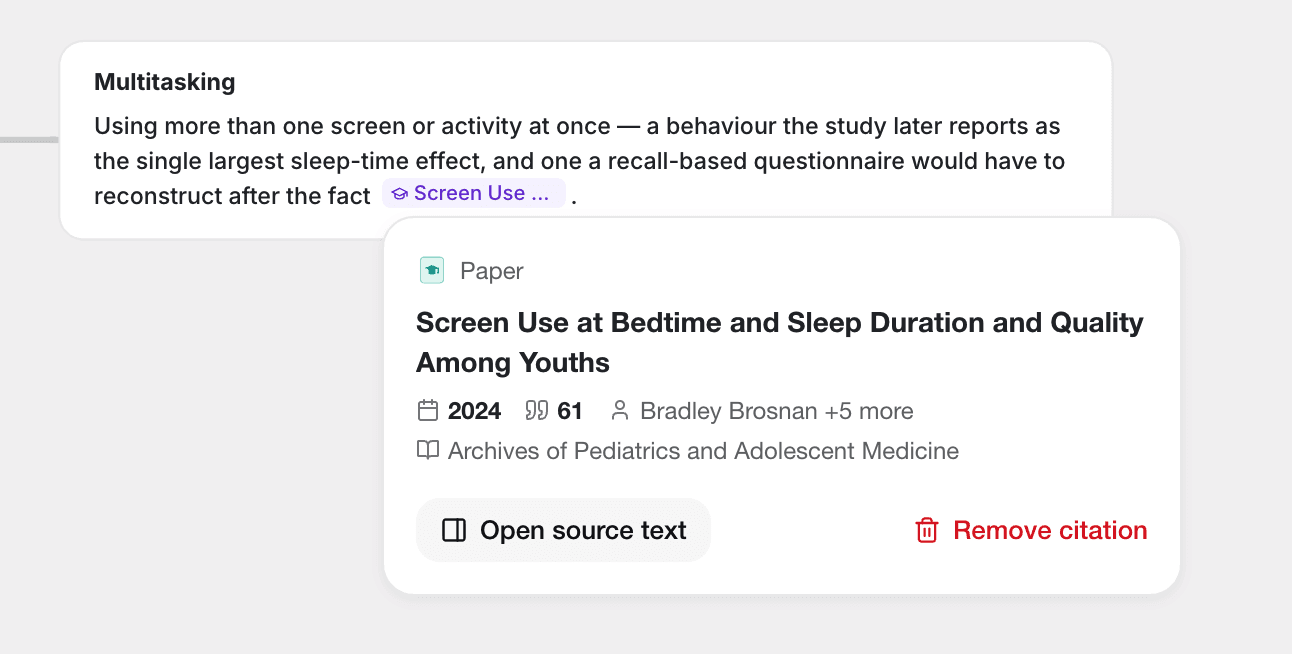
Understanding a paper ends in the paper itself. For any point you plan to write into a manuscript, open the citation and read the context: Ponder's organizing gets you to the right place faster, and the judgment in the source text is yours to make.
Turn a file into a mind map or notes in one step
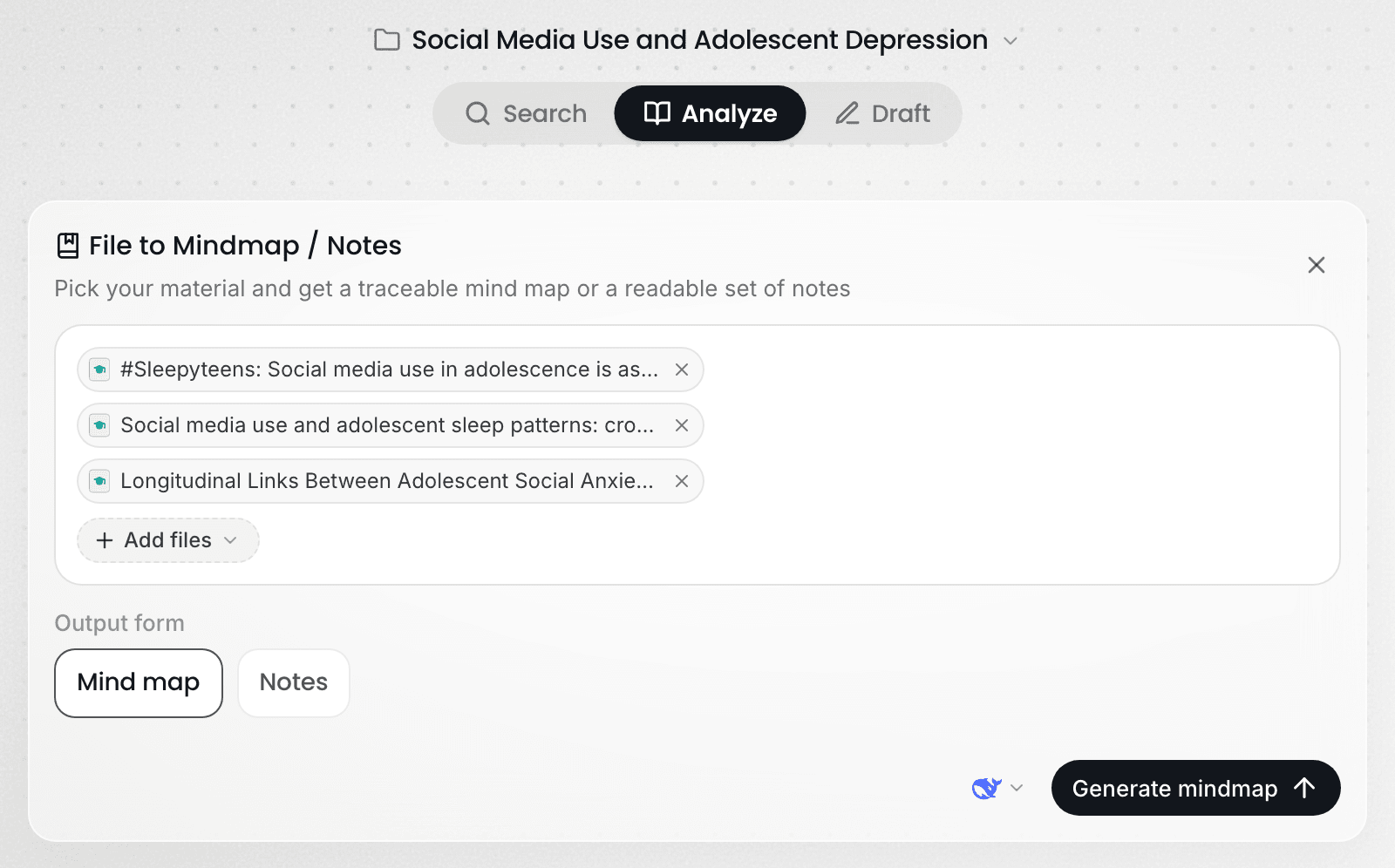
Choose Analyze above the input box, click File to Mindmap / Notes, select the material to read, and set "Output form" to Mind map or Notes. When you generate notes from more than one source, you can also choose Key points or Source structure.
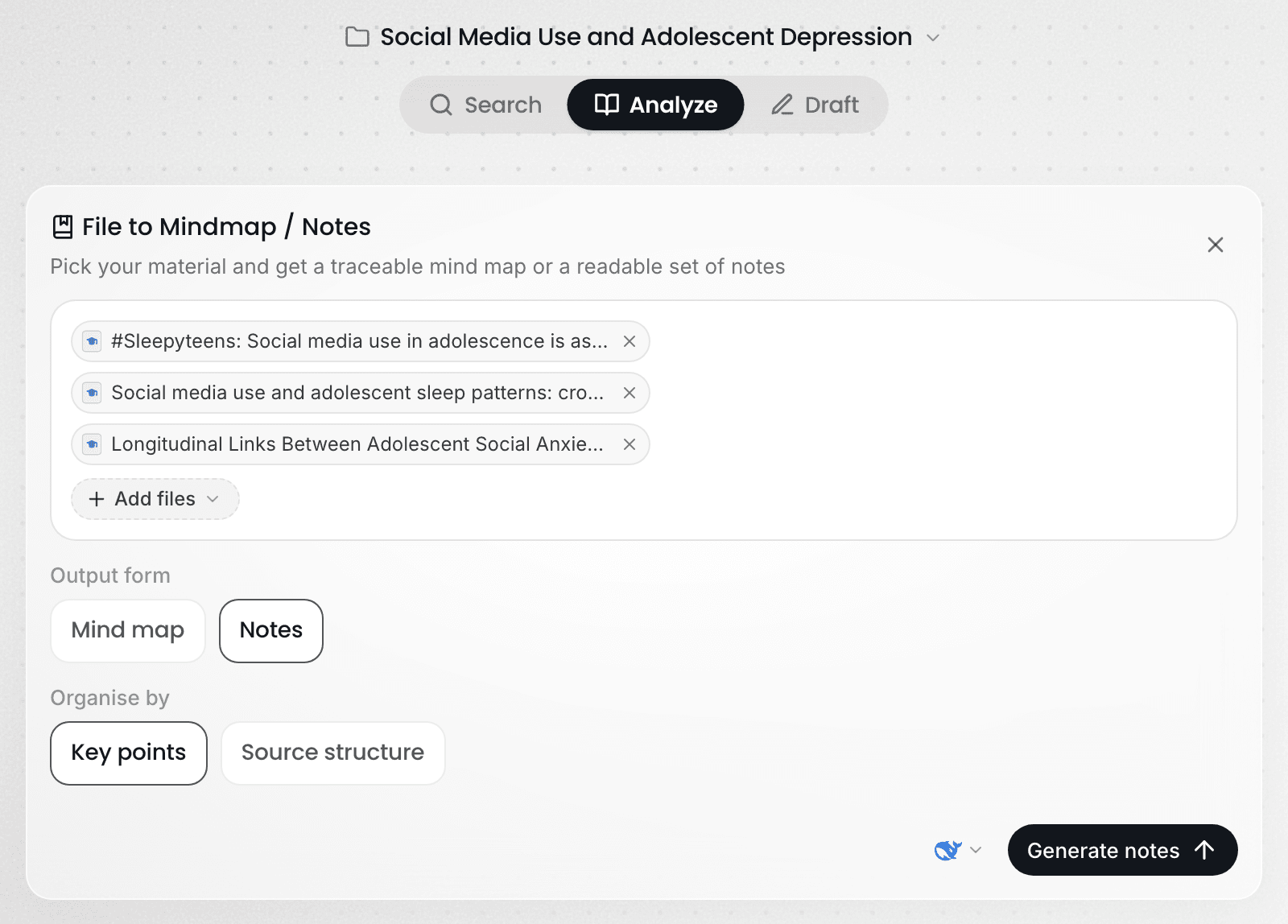
To read a single source, open it and click Analyze at the top, then choose File to Mindmap or File to Notes.
These entry points cover the most common ways of reading. When yours is not among them, just tell Ponder: upload the literature in the input box, or reference literature in the project with @, then write your analysis requirement or question in your own words. For example "Compare how these three papers measure depressive symptoms and lay it out in a table", or "I did not follow the mediation analysis in the second paper — walk me through it against the source text".
For textbooks and lecture notes there is one more way: click Guided Learning, and Ponder walks you through the material step by step with questions.
What to read next
- Write what you have understood into an article: read Academic writing
- Have Ponder search and read closely across several rounds on a topic: read Research a topic in depth
- Export a mind map as an image or PDF: read Export your work